In 2026, super apps are a practical answer to app fatigue. Instead of forcing users to juggle dozens of downloads, one multi-service platform lets them order, book, pay, and chat in a single place with one login and a familiar flow.
The hard part starts when you build it. A super app is really many services inside one shell, and launching on iOS and Android can quickly spiral into:
- runaway costs from duplicated engineering and QA for every service
- release and coordination drag from maintaining two codebases, syncing roadmaps, and shipping more slowly
With almost 10 years in React Native development services, we at Rubyroid Labs recommend this framework as the right tech stack for multi-service app development. With one cross-platform codebase and a modular “mini-app” approach, you can add services twice as fast as when building on native platforms and scale without doubling headcount.
Contents:
- Why super app development is growing in 2026
- Why the WeChat super app model failed in the USA
- Super app architecture: what works best in the US
- Why React Native is a strategic choice for super app development
- Super app tech challenges and how React Native solves them
- Conclusion: when to build a super app with React Native
Why super app development is growing in 2026
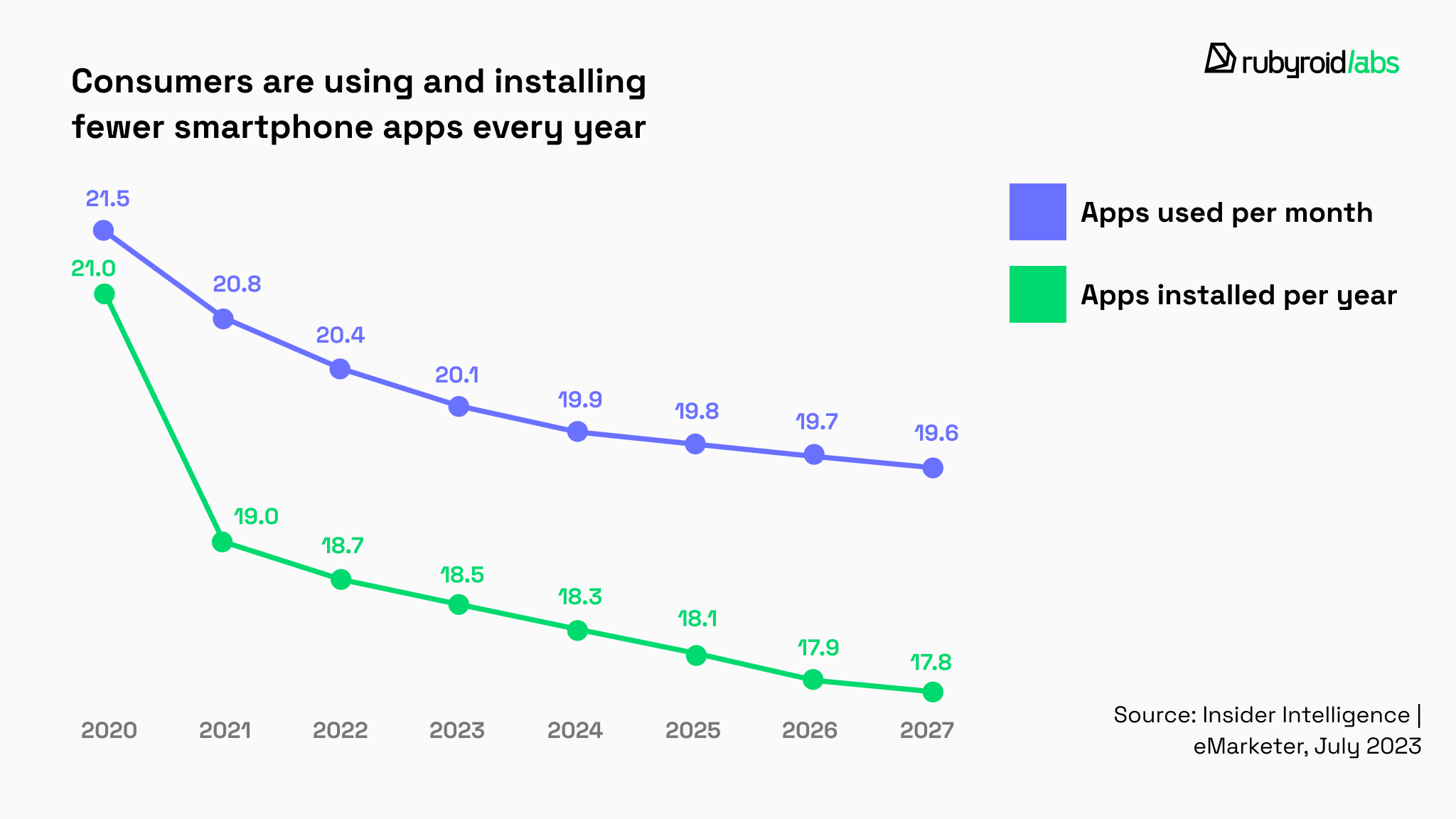
Mobile app installs are dropping year over year.
According to eMarketer research, mobile downloads are falling from 21 apps per year in 2020 to a projected 17.8 in 2027.
The reason is app fatigue and mainly the frustration of being forced to install new apps just to complete basic transactions.
Chinese mobile innovators recognized this early and pioneered all-in-one app development, creating WeChat, what we now call a super app. WeChat evolved from messaging into a platform by adding payments and mini-programs, eventually becoming a daily-life operating system for over 1.3B users.
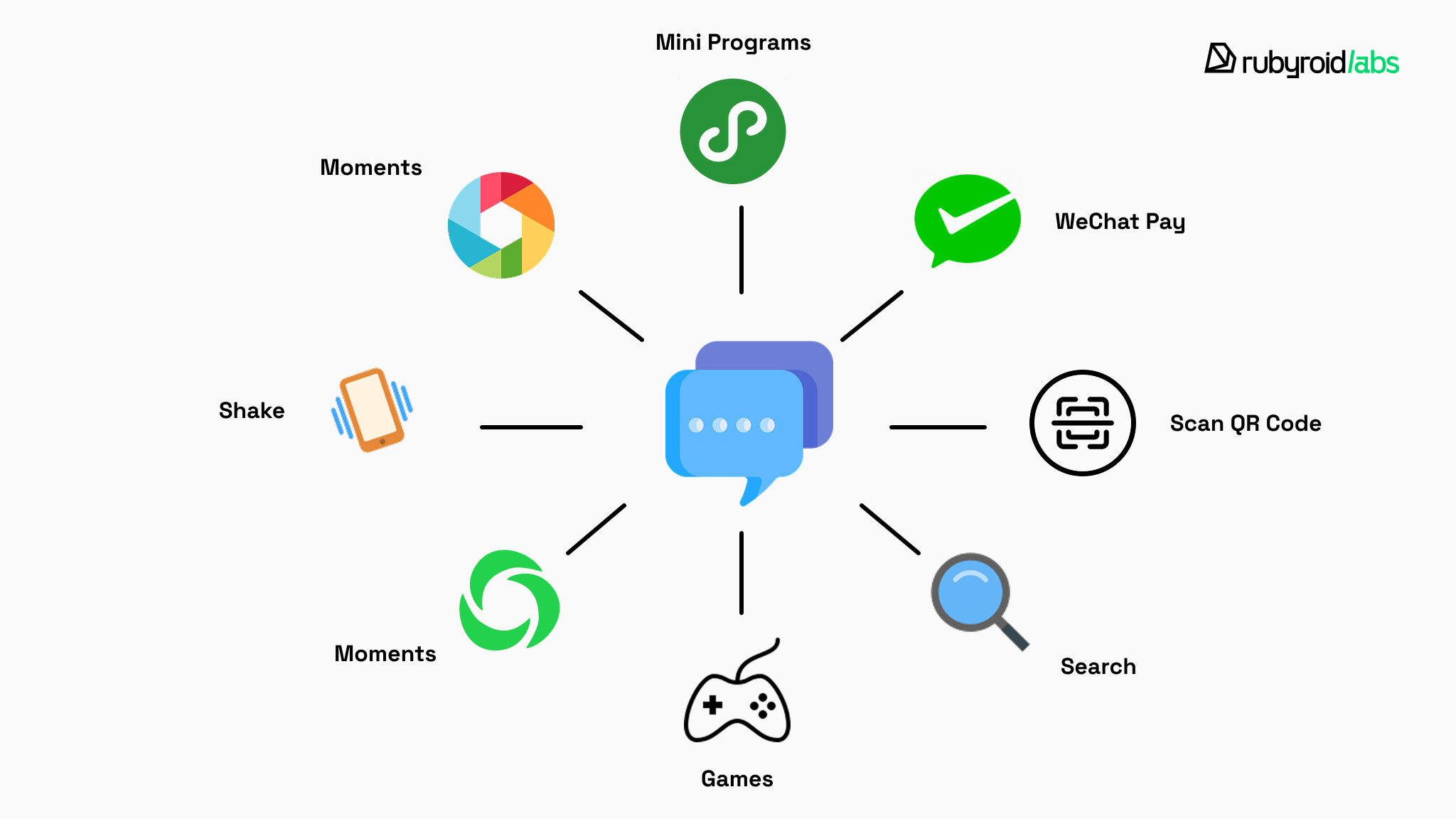
What is a super app?
A super app is essentially a single mobile application that functions as a closed ecosystem of everyday services. Instead of serving one purpose only, it acts as a digital umbrella, covering the most commonly used services in one app.
Normal app vs. super app: key differences
| Dimension | Normal mobile app | Super app |
| Purpose | One primary use case | Multiple services in one product |
| User journey | Users switch apps to complete a task | End-to-end flows stay inside one app |
| Identity & profile | Separate logins and profiles | One login and shared user profile across services |
| Payments | External checkout or per-service payments | Built-in wallet and unified checkout |
| Service ecosystem | Mostly first-party features | First-party and third-party services (mini-apps/partners) |
| Architecture | Single-product codebase | Platform-style, modular architecture with shared core services |

So, with the concept of having many services under one roof, users can keep their smartphone interfaces clean from unused mobile apps by downloading only one.
This idea strongly inspired US tech giants like X (formerly Twitter), Meta, and Uber in 2023 to pursue super app development. Though, few expected the concept to fall flat.
Why the WeChat super app model failed in the USA
In 2023, Silicon Valley executives saw WeChat dominating China and Grab conquering Southeast Asia and tried to replicate the exact model in America. They adopted a horizontal architecture where one platform controls multiple unrelated categories like messaging, payments, shopping, and transportation.
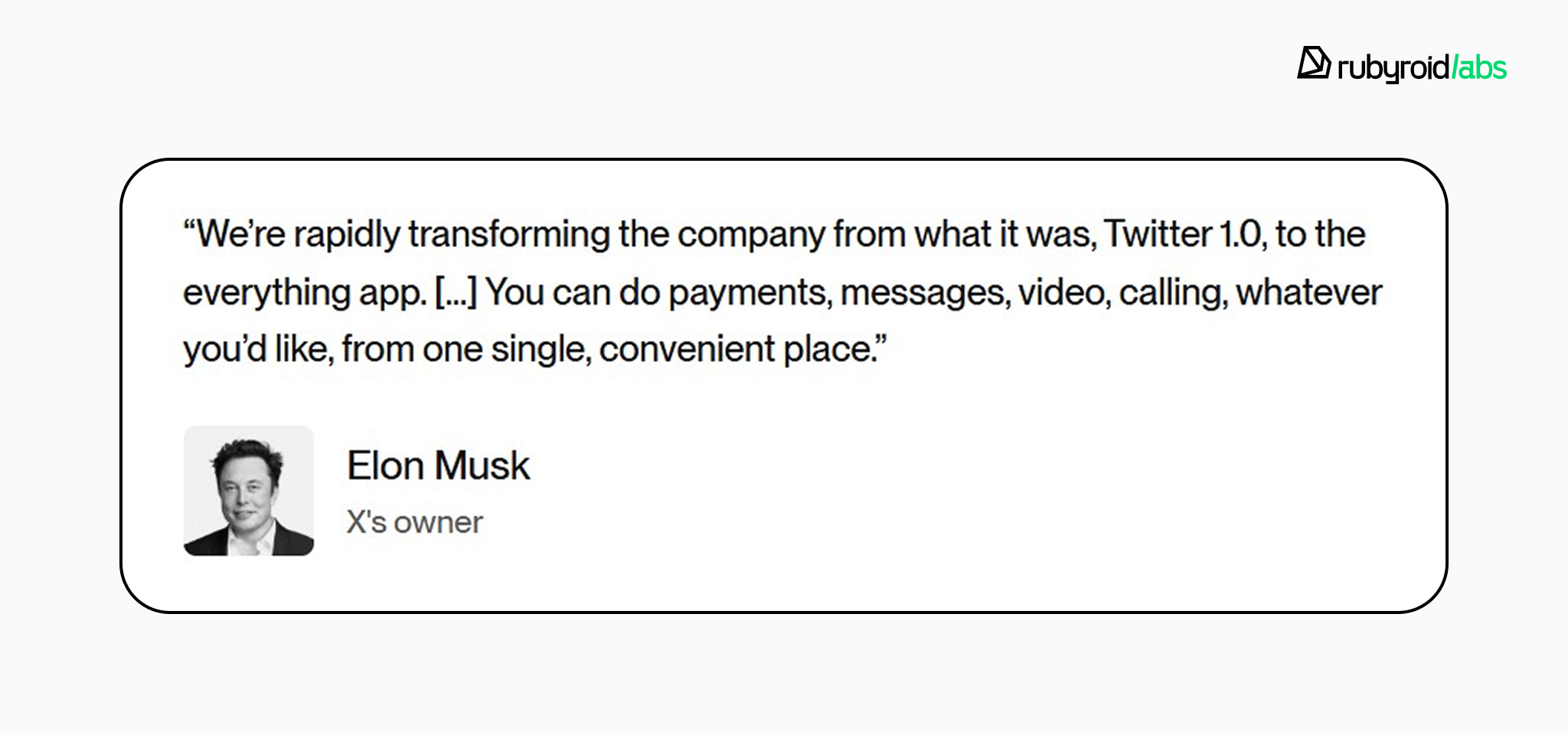
Elon Musk dreamed of transforming X (formerly Twitter) into an “everything app.” The plan was to add payments, encrypted messaging, video hosting, job boards, and banking services, rolling out features aggressively to lock users into the ecosystem.
Meta tried the same horizontal approach with WhatsApp and Messenger, adding peer-to-peer payments, retail storefronts, business messaging tools, and marketplace integrations to transform messaging apps into commerce platforms.
None of those early, forced attempts actually stuck.
4 reasons the classic super app idea failed in the US
- Regulatory and antitrust pressure. The more one app tries to own payments, commerce, and identity at once, the more scrutiny it attracts.
- Entrenched defaults and a fragmented market. Messaging and payments already have strong incumbents, so it’s hard for a new “universal” hub to become the starting point.
- User behavior: convenience with boundaries. Americans consolidate within trusted categories but resist putting messaging, money, shopping, and identity under a single app.
- Technical fragility. When unrelated services share one codebase, a payment bug can crash messaging and coordination kills velocity.
Those constraints didn’t kill the super app idea but reshaped it. Companies realized they needed to bundle services within a single trusted domain rather than across unrelated categories.
Super app architecture: what works best in the USA
American users embraced super apps but only within clearly defined categories. The winning model is vertical scaling. Its core strategy is to start with one high-frequency product users already trust, then expand into closely related services.
For example, Revolut started as a digital bank with cards and currency exchange. Once users trusted them with their money, they expanded across fintech: stock and crypto investing, savings, credit, business accounts, budgeting, insurance, and travel services.
Every service solves a financial need. Users come for cards and stay for everything money-related. That’s vertical expansion: owning one domain completely.
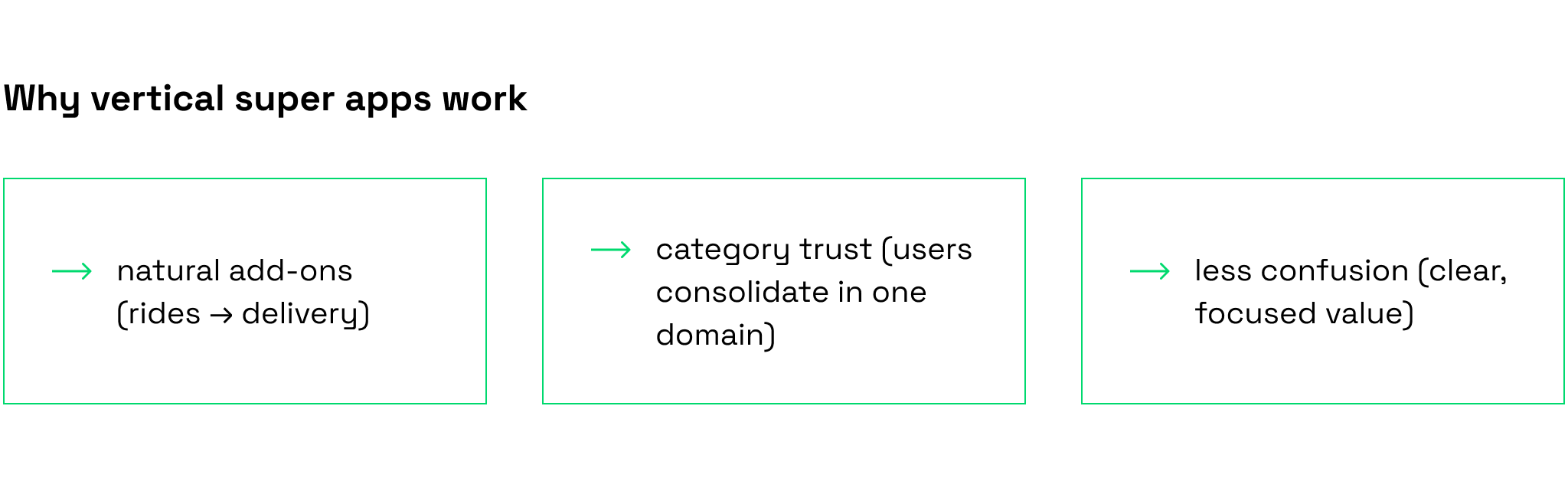
Why vertical super apps work
- Natural add-ons. New services extend an existing habit (e.g., rides → delivery), so adoption feels effortless, not like an upsell.
- Trust stays in bounds. Users accept more features from brands they already trust in that category (Walmart for shopping/pharmacy, not private messaging).
- Clearer value, less confusion. A focused domain makes the app easier to understand, market, and improve without turning into a random “everything” bundle.
The mini-app approach unlocks scalable growth
Vertical super apps require modular architecture: a core shell (identity, payments, security, navigation) with each service as an independent module. Teams ship independently, shared infrastructure stays consistent, and the app remains coherent as services multiply.
But there’s an operational problem: building a core host app plus dozens of service modules across iOS and Android typically means doubling your engineering team. Native development requires separate iOS and Android teams for every service. Ten services need twenty specialized teams.
React Native solves this with one cross-platform codebase.
Why React Native is a strategic choice for super app development
A super app normally includes 5-10 services that have to feel like one product: one login, one checkout, one notification system, and one support flow. The expensive way to do that is to build everything twice once for iOS and once for Android and then repeat that effort for every new service you add.
React Native works differently. Instead of scaling teams and budgets linearly with platforms, you scale the product while keeping most of the code and workflow shared.
For example, we’ve deployed booking systems, interactive maps, and media galleries across 4 travel apps (2 brands × 2 platforms) with a single React Native codebase and reduced development time by 1.9x compared to native approaches. Drawing from years of React Native development services, our team has identified what the framework brings to make multi-service apps sustainable long-term.
Let’s see what React Native brings through the key multi-service app development challenges.
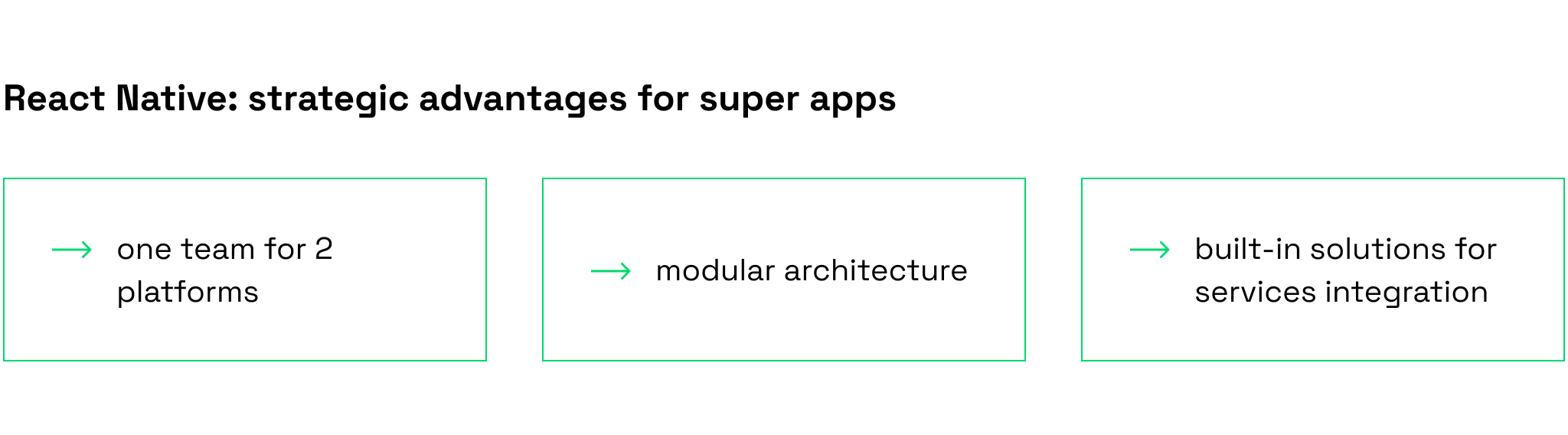
The economics: one team, multiple platforms
In React Native vs native development, “native” usually means two parallel roadmaps (iOS + Android) for each service. As your application expands, the team count and release overhead grow fast, and it becomes harder to keep features synchronized.
With the React Native super app approach, a single product team can ship most flows once through cross-platform mobile development, cutting duplication and helping the product reach a faster time to market. That typically means fewer duplicated engineers, fewer “Android is two sprints behind iOS” problems, and faster launches for new services, so you can test a vertical in weeks, not months, before committing bigger budgets.
The architecture: built for modular app development
Super apps die when teams bottleneck each other. React Native’s scalable mobile architecture lets services ship independently. It means your food delivery team can push a Friday promotion without waiting for the rides team to approve the code.
Tools like Re.Pack and Module Federation support this microservices architecture, keeping teams autonomous while sharing core infrastructure (payments, auth, notifications).
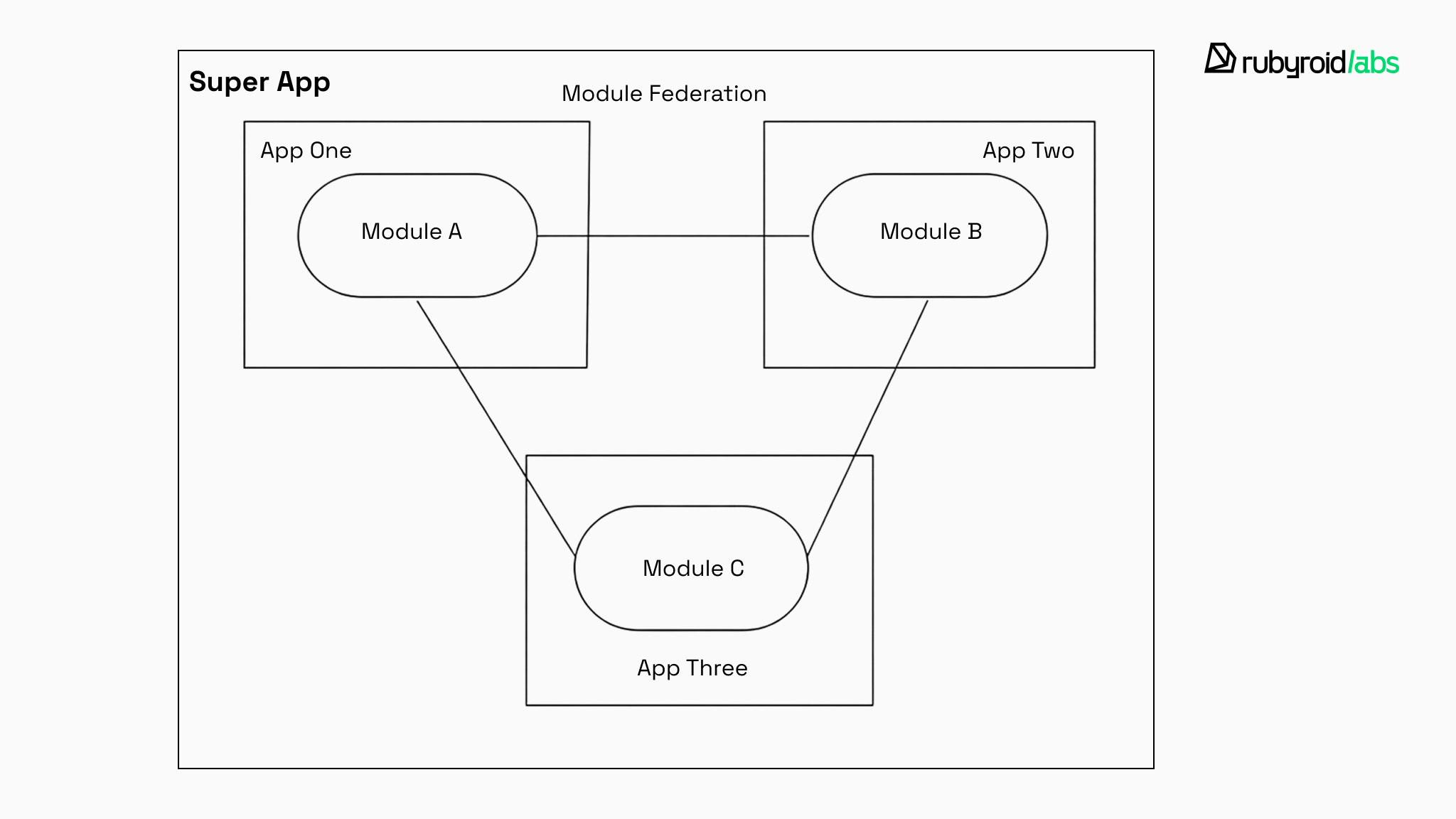
As a result, you can respond to competitors in days instead of quarters, which is the actual advantage in the mobile ecosystem platforms market.
The ecosystem: ready-made solutions for core services
Building payments, maps, chat, and notifications from scratch takes years. React Native gives you plug-and-play API integrations. For example
- Stripe for mobile payments integration
- Google Maps for location
- Twilio for communications
- Firebase for real-time features in apps.
As Meta backs React Native, major providers build official support. You integrate Stripe in a shorter time instead of building payments for months. This compresses, let’s say, a 3-year roadmap into 6 months, and every week saved is revenue you’re capturing while competitors are still in development.
This approach to integrated digital services turns all-in-one app development from a multi-year project into achievable quarters.
What about React Native performance?
The performance of the React Native framework is the subject of debates in many internet resources and among developers, especially the sharp topic of React Native vs Flutter.
In practice, React Native performance is more than enough for most super app flows: navigation, lists, forms, delivery tracking, and payments.
The New Architecture (JSI, TurboModules, Fabric) further improves responsiveness by reducing overhead and enabling smoother UI updates, making 60 FPS interactions realistic for standard screens.
And if a specific feature is truly performance-critical, you can still implement that part in native (via native modules) while keeping the rest of the app cross-platform.

Super app tech challenges and how React Native solves them
Building a super app introduces architectural complexity that single-purpose apps never face. Here’s how React Native addresses each core challenge with specific technical solutions that translate to business outcomes.
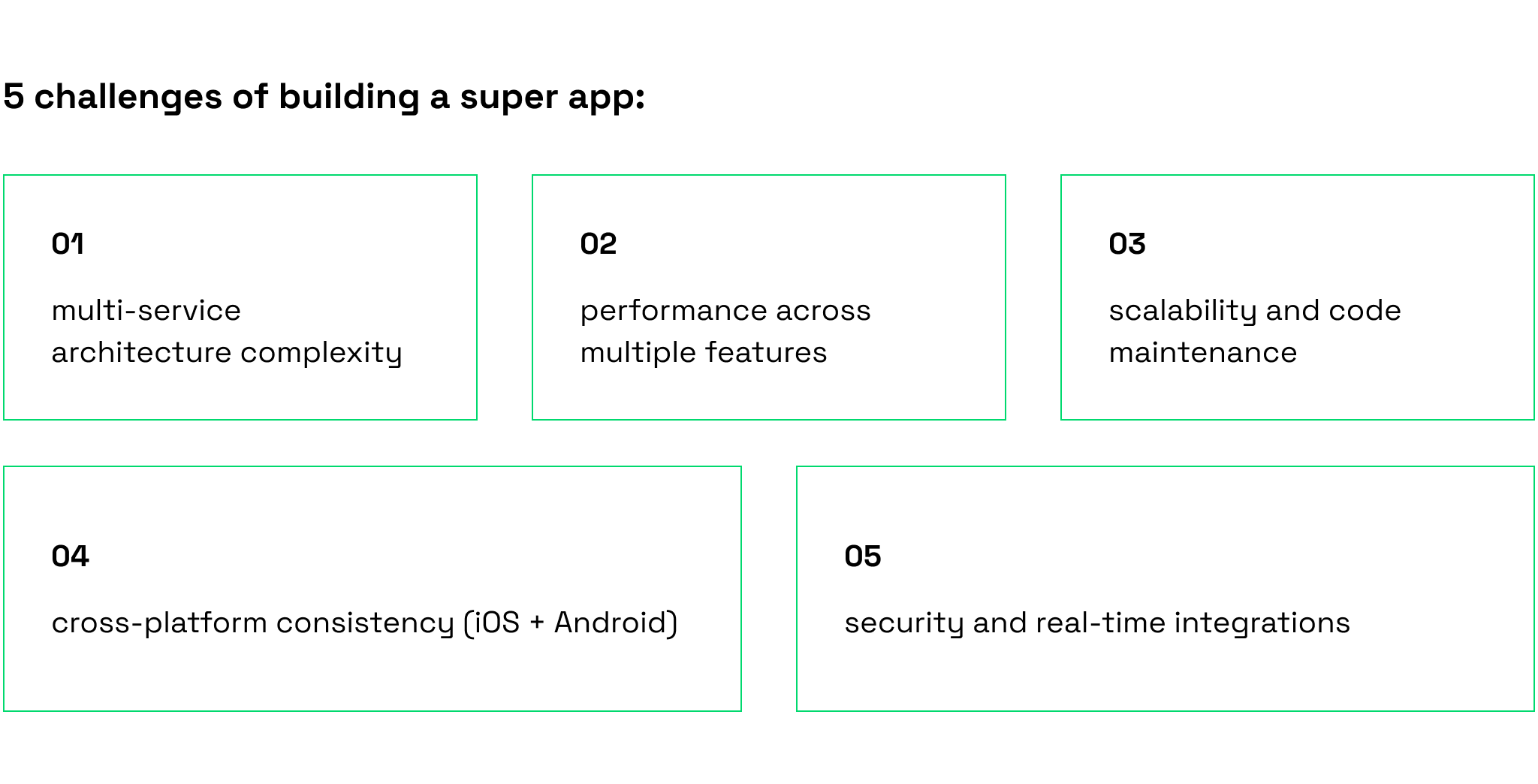
Challenge 1: multi-service architecture complexity
Problem: Different services must live in one app without any module destabilizing the others, and teams must be able to release their parts independently.
React Native approach:
The use of modular mini-app architecture can help: a stable host app (auth, navigation, analytics, crash reporting) + service modules that can be loaded on demand. Tooling like Re.Pack + Module Federation supports code splitting and independent module delivery; TurboModules help load only the native capabilities needed by a given service.
| What it means for your business: Teams can release in parallel, incidents stay isolated, and velocity doesn’t collapse as the number of services grows. |
Challenge 2: performance across multiple features
Problem: Real-time screens (maps, tracking, checkout) can lag when many features run at once.
React Native approach:
The React Native New Architecture significantly reduces this bottleneck:
- JSI enables faster, more direct JS ↔ native interaction.
- Fabric improves rendering responsiveness.
- TurboModules load on native module demand, reducing startup time and memory overhead.
| What it means for your business: This delivers smoother core flows like lists, navigation, and checkout, and fewer performance regressions as features accumulate. |
Challenge 3: scalability and code maintenance
Problem: As services grow, shared dependencies and tech debt make updates risky and slow.
React Native approach:
The framework enforces modular architecture patterns that scale:
- Monorepo support with tools like Nx or Turborepo lets teams share common utilities while keeping service code isolated.
- Shared component libraries ensure UI consistency without duplicating code.
- TypeScript support catches integration errors at compile time, not in production.
- Over-the-air updates through EAS Update allow hot-fixing JavaScript bugs without app store reviews.
| What it means for your business: Maintenance costs stay predictable as you scale. Adding the tenth service doesn’t require refactoring the first nine. When a critical bug hits production, you patch it in hours instead of waiting 2-7 days for app store approval. |
Challenge 4: cross-platform consistency (iOS + Android)
Problem: On native stacks, every service typically needs iOS + Android implementations, which doubles engineering and QA and creates “feature parity drift” (one platform lags behind).
React Native approach:
React Native uses native UI components while providing a unified API:
- iOS renders actual
UIKitcomponents; Android rendersMaterial Design components. - Platform-specific behavior (swipe gestures, haptic feedback, keyboard handling) is handled through well-maintained libraries like react-native-gesture-handler and react-native-safe-area-context, keeping platform differences manageable without duplicating business logic.
- Platform-specific code is isolated using the
.ios.jsand.android.jsfile extensions. - Core business logic (API calls, state management, and validation) is written once and runs everywhere.
| What it means for your business: 70-80% code sharing between iOS and Android cuts development time nearly in half. QA cycles shrink because most bugs reproduce identically on both platforms. |
Challenge 5: security and real-time integrations
Problem: Super apps combine sensitive domains (payments, identity, location, sometimes health/finance) with real-time features (live tracking, chat, instant notifications). Any security gap or flaky integration hits trust and compliance.
React Native approach:
The framework integrates directly with platform-native security features:
- Secure credential storage via iOS Keychain / Android Keystore
- Biometrics (Face ID/Touch ID/fingerprint) through native capabilities
- Real-time features via WebSockets, push notifications (APNs/FCM), and audited SDKs (e.g., Stripe, Firebase, Twilio)
- Where needed, enforce stronger network protections in native layers (e.g., TLS settings, certificate pinning)
| What it means for your business: React Native integrates with established security and payment providers. You plug in audited SDKs instead of building sensitive systems yourself, reducing risk and accelerating time to market. |
React Native solves the core architectural challenges that make super apps difficult to build and maintain. As a result, you get faster launches, lower costs, and systems that scale cleanly as your service portfolio grows from three services to fifteen.
Conclusion: should you build a super app with React Native?
Don’t try to “conquer the world” with an all-in-one app. Let others pay for the expensive mistakes.
In the USA market reality, the smarter path is building a vertical super app. Double down on your domain, earn deeper trust, and add adjacent services that improve retention and LTV without confusing users.
React Native supports that business strategy because it makes expansion financially and operationally sane:
- Lower the marginal cost of each new service. A shared React Native foundation means adding an extra service doesn’t require doubling teams, QA, and release cycles.
- Ship new revenue lines faster, with less risk. Modular architecture lets teams release independently. Launch a module, measure adoption, and iterate without high-stakes full-app releases.
- Turn infrastructure into integrations. React Native’s ecosystem lets you plug in proven providers for payments, maps, notifications, and chat, so you build what differentiates, not commodity infrastructure.
This vertical model is most attractive in industries where you can bundle integrated digital services naturally:
fintech (wallet → payments → savings/credit → rewards)
mobility / on-demand (rides → delivery → subscriptions → local services)
marketplaces (discovery → checkout → logistics → support)
healthcare (appointments → messaging → pharmacy flows, with compliance)
Meanwhile, it’s worth also being pragmatic: React Native is usually not the best fit for gaming-first products, heavy AR/VR, or cases where a large native organization would pay a high switching cost.
React Native gives you the foundation. Your domain expertise and execution determine whether you build the next platform or just another app.