
When you decide to build a minimum viable product, you are effectively placing a bet. From this point, your approach to the development will determine how well your product can scale in the future.
You can go the “disposable” route: build a quick MVP just to validate your hypothesis, then scrap it and start fresh if the idea works. It’s a strategy that exists, but honestly, hardly any project owners have budgets for rebuilds.
The approach we recommend is different: build an MVP that gets your product to users fast while laying a foundation that won’t collapse the moment a thousand users sign up. When built right, your MVP becomes the first floor of a skyscraper, not something you throw away when the load grows.
It’s the philosophy we’ve followed at Rubyroid Labs since 2013. Throughout our journey in web development, Ruby on Rails has been our top technological choice for building strong and lasting projects.
The framework strikes that rare perfect balance between development speed and code quality. You get to market quickly without sacrificing the structure you’ll need for the long haul.
If you’re planning to move fast without sabotaging your future scalability, this guide is your blueprint.
Contents:
- Why Ruby on Rails is ideal for building an MVP
- What “scalable MVP” really means
- Typical scaling challenges and how Rails solves them
- Step-by-step guide: building a scalable MVP with Rails
- Common mistakes to avoid when building a Rails MVP
- Summing up
Why Ruby on Rails is ideal for building an MVP
Let’s dig a little deeper into that “perfect balance” we mentioned earlier.
When it comes to building MVPs quickly without compromising quality, several mature frameworks compete for attention.
Django (Python) excels at handling complex data and has a robust admin panel.
Laravel (PHP) offers elegant syntax and a rich ecosystem of packages.
Express.js (Node.js) provides lightweight flexibility for JavaScript-heavy applications.
All of these are solid choices.
But Ruby on Rails stands out for a specific reason: the framework is designed in a way to remove the friction that typically slows development down. Read our full comparison of Rails vs. other frameworks with the benefits and limitations of each.
In MVP development, Rails standardizes thousands of small decisions, from database structure to file organization to routing conventions. This eliminates the endless debates that plague development teams: which ORM to use, how to structure folders, and whether to write your own authentication or use a library.
So, instead of configuring the environment and writing boilerplate code, developers focus entirely on your unique business logic.
As a result, you get from “zero” to “live” faster, with cleaner code, and without the chaos that comes from reinventing the wheel at every step. This is why Rails MVP development consistently delivers better outcomes than other approaches.
Here’s what makes it work:

- Rails operates on a philosophy called “Convention over Configuration.” Instead of forcing your team to manually set up every database table or route from scratch, the framework handles the repetitive setup work. So, the dev team can go straight to building the features that actually sell your product.
- Whatever complex feature you need like payment gateways or image processing, there is likely already a “Gem” (library) for it. There’s no need to write code that has already been written perfectly by someone else. The team just plugs in the solution, tests it, and keeps moving.
- Ruby on Rails has one of the largest and most active communities. It means that thousands of developers are constantly spotting bugs, updating security, and keeping the tech stable. You aren’t betting your business on unproven software.
- In some projects, speed equals budget. As the framework drastically cuts down the hours needed for standard development tasks, your Rails MVP cost becomes significantly lower at launch. It allows you to spend your budget on market testing rather than six months of invisible infrastructure code.
- RoR includes protections against common nasty attacks (like SQL injection) right out of the box. It covers your MVP automatically, so you don’t have to worry about rookie security mistakes slipping into production.
When you add it all up, you get a framework that respects your budget and your roadmap. It lets you move fast without breaking things. This mix of practical advantages is why many project owners and startups choose RoR for MVP development.

What “scalable MVP” really means
By a scalable MVP we often understand a small version of a product with a couple of core features that can potentially hold an increasing amount of users and still perform well without breaking.
However, that’s not all. A truly scalable product is a foundation that can grow in multiple directions without collapsing under its own weight.
In this context, Rails gives you everything you need to build such a foundation: rapid development without sacrificing code quality, proven architectural patterns that prevent technical debt, and a structure that evolves with your business.
Let’s break down what that actually means in practice.
Scalability: ability to handle high user loads
As we already stated, scalability is the system’s ability to perform the same under 10,000 simultaneous users as under 100 users.
This comes down to infrastructure choices, database optimization, caching strategies, and how efficiently your code executes. When you build an MVP with Ruby on Rails, you can be sure your product is designed with growth in mind from day one.
Rails provides proven, production-ready tools for scaling:
- ActiveJob with Sidekiq for background processing keeps your application responsive even during heavy workloads
- Action Cable enables real-time features without blocking your main application thread
- Fragment caching and Russian Doll caching dramatically reduce database load as part of comprehensive Rails caching strategies
- Database query optimization through ActiveRecord prevents the N+1 queries that kill performance
- Horizontal scaling through load balancers and multiple application servers via Rails hosting options like Heroku, AWS, or DigitalOcean
- Rails monitoring tools like New Relic, Scout APM, or Skylight help you spot performance bottlenecks before they become problems
As an example, take Twitch. The platform began as Justin.tv, a Rails app streaming just one guy’s life 24/7. When the team pivoted to gaming, thanks to the Rails architecture, they didn’t rebuild from scratch but simply expanded it.
What started as a single-channel experiment evolved to manage millions of users, handle complex authentication, coordinate live chat, and orchestrate thousands of simultaneous broadcasts. The framework that powered one video stream scaled all the way to a $970 million Amazon acquisition.
Expandability: ability to add features
Expandability is needed for MVP’s flexibility in the future. When you want to add new features like integrating a payment gateway, building an analytics dashboard, or launching a mobile app, that shouldn’t be painful for the core system.
An expandable MVP has a modular architecture where new features can be added without rewriting existing code. The codebase is organized logically, APIs are well-structured, and the code follows consistent patterns that make it easy for developers to extend functionality.
Rails excels here through its ecosystem and architectural patterns:
- 80,000+ Ruby gems mean most features already have battle-tested solutions (Stripe for payments, Devise for authentication, Sidekiq for job processing)
- RESTful routing conventions make API development straightforward and consistent
- Service objects and concerns let you extract complex business logic without cluttering your models
- Rails Engines allow you to build modular, reusable components
- ActiveRecord callbacks and observers enable clean event-driven architecture
We saw this in action when developing Full-Kitchen. While the user interface was built with React Native for a seamless mobile experience, the backbone of the operation was a Ruby on Rails API. As the platform grew and needed complex kitchen management logic, the modular nature of the Rails backend allowed us to extend the API and plug in third-party services without disrupting the mobile app.
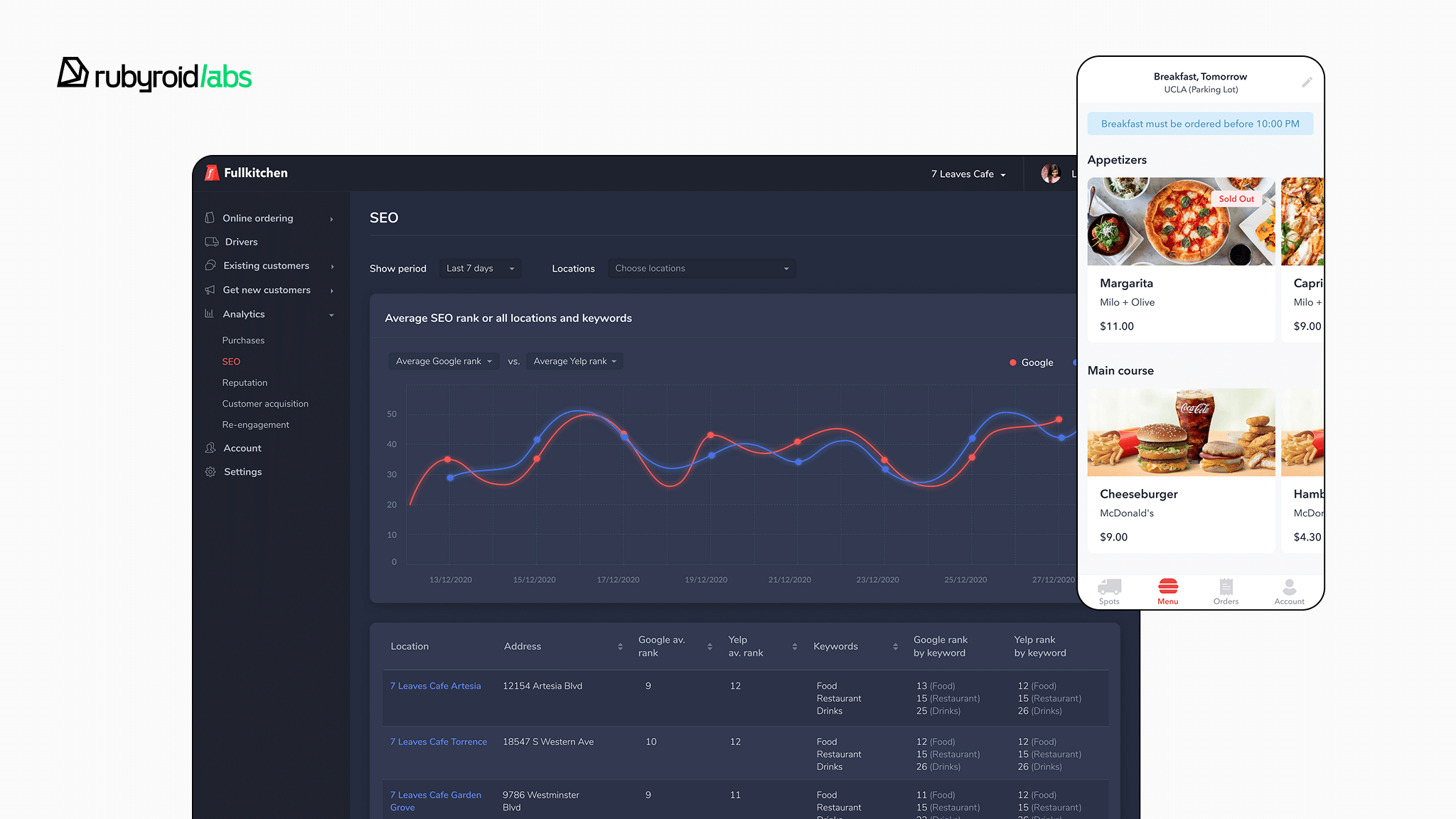
As a result, the product evolved naturally alongside business needs, rather than hitting a “feature ceiling” that required a backend rewrite.
Maintainability: clean architecture
Maintainability ensures that your app can grow without becoming a nightmare to work with.
A maintainable MVP has clean, well-documented code that follows established conventions. It includes automated tests to catch bugs before they reach production. The architecture is straightforward enough that new developers can onboard quickly, and changes in one part of the system don’t randomly break features elsewhere.
RoR promotes maintainability as its core philosophy:
- Convention over Configuration means any Rails developer can navigate your codebase immediately
- Built-in testing frameworks (RSpec, Minitest) make automated testing natural, not an afterthought
- MVC architecture enforces clean separation of concerns
- Strong naming conventions eliminate guesswork about where code belongs
- Active community standards (Rubocop, Rails Best Practices) keep code quality high
Most founders underestimate how much this matters. Zendesk started with three developers building help desk software on Rails to move fast on complex ticket logic.
Today, they’re a multi-billion dollar company serving Uber and Slack, running on that same Rails codebase. No rewrites, just continuous evolution from startup to publicly traded enterprise. That’s maintainability in action.
In our article about 8 world-famous MVP examples, we uncover how top companies built Ruby on Rails MVPs that turned into billion-dollar businesses.
Typical scaling challenges and how Rails solves them
Building your MVP is just the first step. Once it’s live and real users begin to engage with it, the pressure increases. Features evolve, user expectations grow, and your product must keep up.
This is the stage where many early-stage products either scale successfully or start to fall apart.
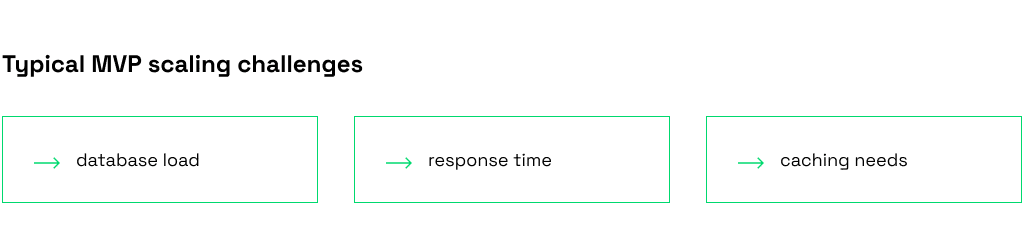
In this chapter, we’ll explore three of the most common technical scaling challenges startups face. You’ll also see how Ruby on Rails is well-equipped to address these challenges and we’ll look at real-world product failures that highlight what can go wrong when these issues are ignored.
Database load: managing increased demand on your data layer
As your user base grows, so does the volume of read/write operations on your database. If not handled properly, this can lead to slow queries, timeouts, and even downtime.
How Rails helps:
Rails offers powerful tools through Active Record to write efficient queries and avoid common performance issues like the N+1 problem. You can use eager loading to reduce query counts, indexes to speed up lookups, and background jobs (with tools like Sidekiq or Solid Queue) to offload heavy tasks. Combined with database monitoring and optimization tools, Rails helps you keep performance smooth as traffic increases.
Response time: keeping the app fast as it grows
Users expect fast load times and as your app scales, server response time can degrade due to heavier traffic, more complex pages, and slower APIs.
How Rails helps:
Rails includes built-in support for fragment caching, Russian doll caching, and now Solid Cache, which help reduce rendering time by storing parts of your views or data. With Hotwire (Turbo + Stimulus), Rails also offers a modern approach to building fast, reactive interfaces without relying on heavy JavaScript frameworks. These tools help keep your app responsive even as demand grows.
Caching needs: avoiding repeated work
Without caching, your app wastes resources by performing the same expensive operations repeatedly which impacts performance and increases server load.
How Rails helps:
Rails provides a caching system that’s easy to implement and powerful enough to handle complex use cases. You can cache pages, partials, or low-level data and use Solid Cache for persistent, key-based storage. Integrations with tools like Redis or Memcached give you even more flexibility as your app scales.
Scaling challenges are inevitable as your MVP gains traction but they don’t have to be painful. Ruby on Rails offers a robust set of tools that help you solve performance, database, and caching issues early, so you can focus on what matters most: growing your product and serving your users.
Thanks to Rails’ mature ecosystem and thoughtful design, you can start simple and scale gracefully without ever needing to rebuild from scratch.
Step-by-step guide: building a scalable MVP with Rails
To avoid possible scaling challenges that often come with launching an MVP, you need a disciplined roadmap. Just coding is not enough, so you need a strategy that protects your budget while keeping the door open for growth.
Here is a 10-step process we recommend you check up with your development team to ensure your MVP will be of high quality.
1. Start with clear, validated requirements.
Before writing code, define what your MVP must do. Focus on core functionality that validates your idea. Map out user flows, define success metrics, and validate =assumptions using mockups or interviews. This upfront clarity saves time and money later.
Tip: If you can’t explain the core value of your app in one sentence, you’re not ready to build it.
2. Set up your Rails project with the right tools
Start with a stable foundation. Use the latest Ruby on Rails versions, and include essential gems like Devise for authentication, Pundit for authorization, Turbo/Stimulus for interactivity, Sidekiq for background jobs, and RSpec for testing. Stick to Rails conventions as they exist for a reason.
Tip: Avoid over-customizing your setup before the product has users. Rails’ defaults exist for a reason.
3. Use a clean, modular architecture
Good architecture helps your app scale without chaos. Stick to MVC, but avoid bloated controllers and models. Use service objects for business logic, form objects for complex validations, and presenters to keep views clean and organized.
Tip: You don’t need microservices to scale. At this stage, you need clean, organized monoliths.
4. Design a scalable database from the start
Choose PostgreSQL for its reliability and scalability. Add indexes to frequently accessed fields and design migrations to be clean and reversible. A thoughtful schema now prevents painful rewrites later.
Tip: Design tables with future reporting and querying needs in mind.
5. Build only what you need to learn
Start with the features that test your core hypothesis. Add authentication, user onboarding, and essential CRUD functionality. If needed, expose simple API endpoints. Use third-party services and gems where it saves time.
Tip: If a feature doesn’t help validate your idea, save it for later.
6. Optimize performance where it matters
Don’t over-engineer, but do prepare for the basics. Use fragment and Russian doll caching for views. Set up Redis for fast cache storage. Use Sidekiq for background jobs, and prevent N+1 queries with Bullet and eager loading.
Tip: Optimize the slowest paths first, as not everything has to be blazing fast on day one.
7. Plan for growth and flexibility
Even small apps should be easy to evolve. Use feature flags to release iteratively. Keep your code modular with concerns or service layers. For large apps, Rails Engines can help separate features cleanly.
Tip: Think of every new feature as something you might want to remove or refactor later.
8. Make enough tests
Testing is one of the most important investments you can make in your MVP. It gives you confidence that as your product evolves, you’re not accidentally breaking functionality that already works.
Focus on what matters: model specs, critical endpoints, and core user flows. Use RSpec for readable, maintainable test code. Set up continuous integration (CI) to automatically catch issues before they ever reach production.
Tip: A failing test in CI is cheaper to fix than a broken feature in production.
9. Deploy to a scalable, developer-friendly environment
Choose a platform that lets you deploy quickly and scale with ease, like Heroku, Render, Fly.io, or AWS are all solid choices. Docker can help with consistency if your team or infrastructure grows. Add CD pipelines and rollback plans for extra confidence.
Tip: You don’t need Kubernetes to launch an MVP, simplicity wins early on.
10. Monitor everything from day one
Visibility helps you grow with confidence. Use New Relic or Datadog to monitor performance. Track errors with tools like Sentry or Honeybadger. Watch logs for slow queries, job failures, and timeouts, especially after releases.
Tip: Monitoring helps you find problems before users do.
A successful MVP is one that’s fast to build, easy to learn from, and ready to grow. Rails gives you the tools to do exactly that, and by following these steps, you’ll avoid common pitfalls that can slow down or sink a good idea.
Common mistakes to avoid when building a Rails MVP
We’ve covered what you should do to build a scalable, successful MVP. Now, let’s talk about the traps. They are the missteps that can quietly undermine your product before it even has a chance to grow.
Some of these mistakes are technical, while others are strategic. But all of them are avoidable if you know what to watch out for.
Technical mistakes
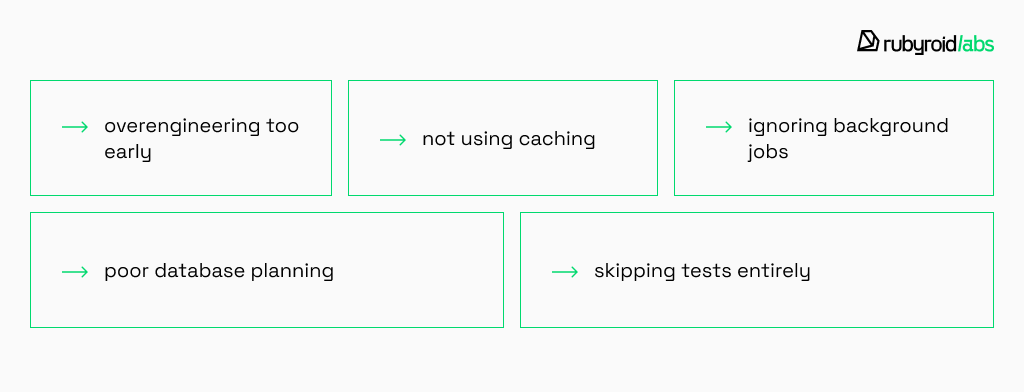
1. Overengineering too early
It’s tempting to build for the future from day one, but overengineering before you have real users is a costly trap. Complex architecture, layers of abstraction, or overuse of patterns (like microservices) can slow down development and make early iterations harder.
The solution is to build what you need to validate your idea, nothing more.
2. Not using caching
Caching is one of the easiest ways to improve performance, especially for database-heavy views or slow-loading pages. Ignoring it means your app will slow down as traffic grows, and that leads to poor user experience and higher hosting costs.
Our advice is use fragment caching, Russian doll caching, and tools like Redis early on.
3. Ignoring background jobs
Handling everything in real-time can block users and overwhelm your app. Tasks like sending emails, processing files, or calling APIs should run in the background. Skipping background jobs leads to slower requests and frustrated users.
Sidekiq and Active Job are the best friends to use from the start.
4. Poor database planning
Your database schema is the backbone of your product. Without thoughtful planning, you risk performance issues, migration headaches, and painful refactors. Skipping indexes or over-normalizing too early can lead to major roadblocks down the road.
Start with PostgreSQL, use proper indexes, and keep migrations clean and reversible.
5. Skipping tests entirely
Skipping tests is one of the riskiest mistakes you can make when building your Rails MVP. Without them, every change becomes a guessing game. Bugs slip through, refactoring gets risky, and technical debt builds up fast.
Even a small, well-placed test suite covering models, key endpoints, and critical flows, gives you the confidence to move quickly without breaking things.
It’s always safer (and cheaper) to catch a failure in CI than to fix a broken feature in production.
Costly strategic mistakes that killed MVPs
While technical issues are often solvable, strategic missteps are much harder to recover from.
The examples below show product failures that resulted from ignoring the market and skipping validation entirely. Each one proves a hard truth: even the biggest budgets can’t save a product that nobody needs.
1. Launching without validation
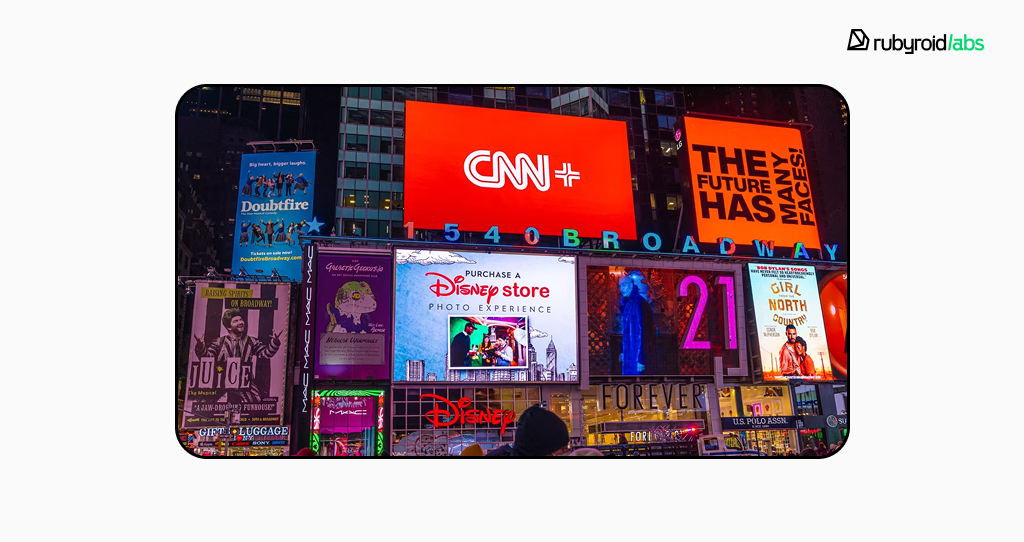
CNN+ launched as a premium streaming service, supported by a $300 million budget, hundreds of new hires, and enterprise-level infrastructure. The assumption was that CNN’s brand alone would attract paying subscribers. But users weren’t interested in paying for content they already consumed for free on cable or social media. The platform was shut down just one month after launch.
The mistake: building the full product before confirming user demand.
The lesson: even the strongest brand can’t replace product-market fit. A lean MVP should be used to validate real demand before scaling the product or team.
2. Prioritizing technical polish over product-market fit
Quibi raised $1.75 billion to build a platform for short-form, Hollywood-style video content designed for mobile users. The app featured impressive engineering, like seamless screen rotation and high production quality. However, the fundamental assumption was flawed: most users didn’t want to watch 10-minute cinematic videos on their phones. Six months after launch, Quibi shut down.
The mistake: over-investing in engineering and UX without testing the core idea.
The lesson: a polished experience cannot compensate for a weak concept. The primary goal of an MVP is to validate if the idea solves a real problem.
3. Failing to design for the first user
Color secured $41 million to launch a location-based photo-sharing app. The backend infrastructure was complex and technically impressive. But when users opened the app, they often found no one nearby, resulting in an empty, confusing experience. The UI was unclear, the functionality was dependent on simultaneous usage, and users quickly abandoned the app.
The mistake: releasing a product that only works when many users are present with no value for early adopters.
The lesson: your MVP must deliver immediate value even if only one user is online. Products that depend on network effects need a thoughtful “cold start” strategy, and intuitive UX is essential from day one. This is why early investment in UI/UX design is critical and helps validate the experience before any code is written.
At Rubyroid Labs, we guide you through every stage of MVP development from defining a clear roadmap and delivering thoughtful UI/UX design to robust product development, launch, and long-term maintenance.
Summing up
If there’s one key takeaway from this guide, it’s this: speed doesn’t have to come at the expense of quality.
For years, founders were told they had to choose between building fast and messy, or slow and perfect. Ruby on Rails proves that’s a false choice. It lets you validate your idea in weeks while giving you a foundation that works for ten users and scales to a million.
Your MVP isn’t a throwaway prototype. Like a seed, it reflectsо your company and philosophy.
And that’s why it should be thoughtful. What seems like a small oversight today becomes a major roadblock tomorrow. If you choose the wrong architecture now, you’ll be rewriting code when you should be acquiring customers. If you skip basic optimizations early, you’ll spend months firefighting performance issues instead of building new features.
But the good news is that you now have the blueprint. You know which decisions matter on day one and which can wait. You understand how to avoid the common pitfalls that force startups to choose between technical debt and starting over.
The next step is execution.