
The era of hiring “just in case” and over-engineering is over.
2026 is bringing the philosophy of lean execution: shipping fast, validating early, and managing budgets thoughtfully.
This reality has sparked a quiet renaissance for Ruby on Rails. Instead of choosing a trendy stack or filling a room with ten developers “just to be safe,” the focus is now on outcomes instead of process. Rails fits this efficiency mindset perfectly, allowing small, skilled teams to build real products fast, often outperforming massive enterprise departments.
But Rails is just the power tool. To get measurable results, you need a partner who understands your users, your constraints, and how to build a product that ships and sells.
That’s the lens we used for this list. We’ve prepared the top 11 Ruby on Rails companies in the USA that consistently deliver what matters most in 2026: speed, business-focused solutions, and partnerships that extend beyond the codebase.
Contents:
- Why scalable Ruby on Rails solutions win in 2026
- 11 best Ruby on Rails development companies in the USA
- Hire Ruby on Rails developers USA: 2026 checklist
- Wrapping up
Why scalable Ruby on Rails solutions win in 2026
Step by step, companies are moving away from expensive, over-complicated microservices systems that delay time to market.
In 2026, the winning strategy is different: it’s better to release a simpler product, test it with real users, and iterate based on actual data rather than assumptions.
Ruby on Rails thrives in this environment. If you compare RoR vs. other frameworks, you may see how frameworks such as Node.js, for example, require larger teams and longer timelines to reach production.
RoR lets you move fast without sacrificing quality. Here’s why it remains the smartest choice for product-focused teams.
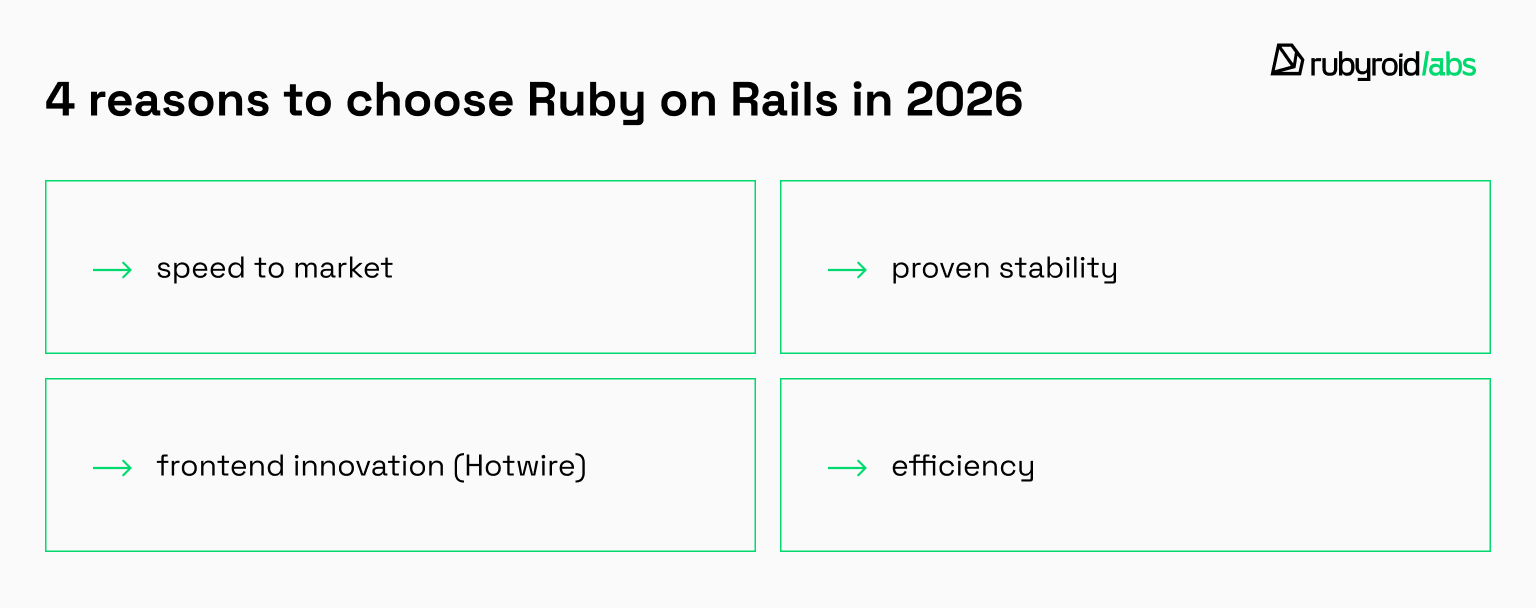
1. Speed to market: the “batteries-included” advantage
If you build with a fragmented stack (like many JavaScript-based setups), a team spends the first month just making decisions.
- Which library for testing?
- Which one for authentication?
- How do we glue them together?
Rails eliminates that decision fatigue. It comes with “batteries included,” meaning the essential tools for testing, mailing, security, and database management are built-in and standardized. Developers don’t waste time inventing plumbing; they start building actual product features on Day One. In a year like 2026, where speed is survival, that head start is invaluable.
2. Stability: validated tech vs. market chaos
While other frameworks undergo painful rewrites every few years that break code (forcing businesses to pay for upgrades that add no new value), Rails is famous for its mature stability. It evolves, but it respects legacy. This is “boring technology” in the best possible way. It means you aren’t paying a team to fix what broke during an update; you’re paying them to build what customers want next. For a business owner, that predictability is gold.
3. Frontend innovation (Hotwire)
For years, building a dynamic interface meant doubling your budget to hire a separate React or Vue team. Hotwire (standard since Rails 7) changed the equation. It allows developers to stream HTML updates directly to the user’s browser, delivering the snappy, interactive feel of a Single Page Application (SPA) without the complexity of a separate frontend codebase.
You get a modern, high-speed UX while keeping your development stack lean and your costs down.
4. Efficiency: the “one-person framework”
Continuing the previous point, Rails allows a single skilled full-stack developer to build an entire modern application, including frontend, backend, and database, without needing a massive support team. If you’re building a product that doesn’t require a super dynamic interface, you don’t need a separate frontend React team and backend API team fighting over contracts. You just need a small, cohesive unit.
This dramatically lowers the burn rate and simplifies communication, keeping the product vision pure.
And of course, we cannot omit the fact that many global giants have their backends built using Ruby on Rails.
Airbnb
Airbnb used Ruby on Rails to disrupt the entire hospitality industry. It was the engine that powered their rapid evolution from a small startup to a global giant. While their stack has grown complex over time, Rails proved it could handle complex bookings, secure payments, and rapid global scaling when it mattered most, getting them to market dominance.
Dribbble
As the world’s leading destination for designers, Dribbble hosts millions of high-resolution images and interactions every day. They chose Rails for its ability to manage heavy media content and complex social features (likes, hiring boards, portfolios) while maintaining a small, efficient engineering team.
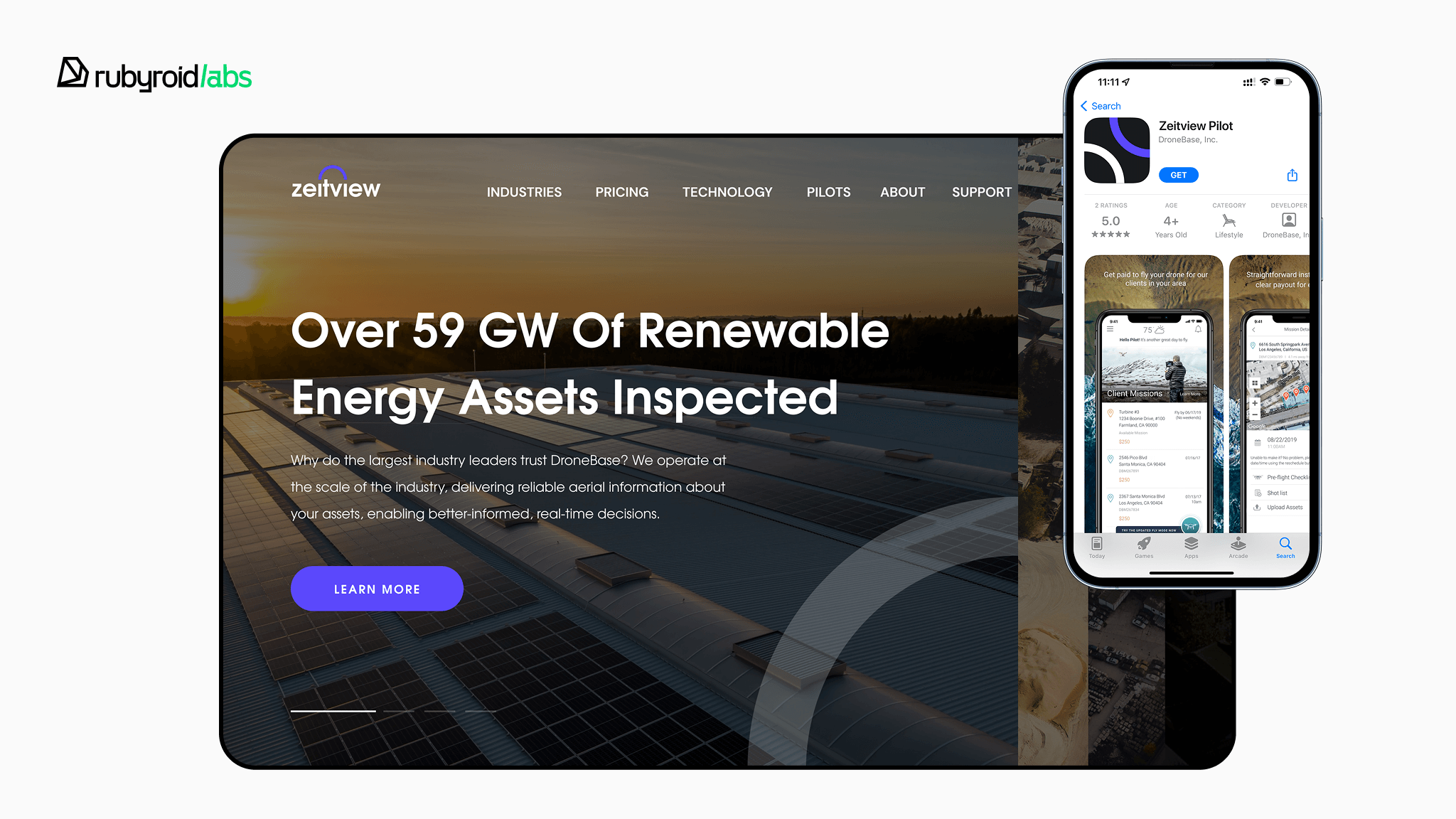
Zeitview
Zeitview is a complex aerial analytics platform built with Rails. Its system manages thousands of drone pilots and processes massive amounts of aerial data for enterprise clients. RoR allowed us to build complex workflows and data processing tools rapidly, helping them scale from a startup into the leader in aerial intelligence.
If you’ve already picked Ruby on Rails as your core stack, that’s a genuinely smart move. You’re choosing an engine built for shipping: fast to start, reliable under load, and economical to maintain when the roadmap gets busy.
The next question is simpler, but it matters more than most people expect: who’s going to drive it with you, make the right trade-offs, and keep delivery steady when priorities change? Let’s uncover the best Ruby on Rails agencies in USA.
11 best Ruby on Rails development companies in the USA
We’ve spent a dozen years in the trenches, and here’s the uncomfortable truth. A lot of Ruby on Rails developers are really just staffing brokers. They’ll assign a developer, bill hours, and leave you to manage the risk, the roadmap, and the outcomes.
So, the code is rarely the real problem. The challenge is finding a partner who understands the business behind the product, not just the framework. That’s what every product owner needs, and it’s the filter we used here and defined .
Here’s the list of 11 Ruby on Rails development companies USA that stand out for execution, communication, and product-focused delivery.
| Rank | Company | Clutch rating | Avg. hourly rate | Min. project size | US headquarters/primary loc. |
| 1 | Rubyroid Labs | 5.0 ⭐ | $50 – $99 / hr | $10,000+ | Springfield, IL |
| 2 | The Gnar Company | 5.0 ⭐ | $150 – $199 / hr | $25,000+ | Boston, MA |
| 3 | Goji Labs | 5.0 ⭐ | $100 – $149 / hr | $25,000+ | Los Angeles, CA |
| 4 | JetRockets | 4.9 ⭐ | $50 – $99 / hr | $25,000+ | Brooklyn, NY |
| 5 | SoftSuave | 5.0 ⭐ | < $25 / hr | $25,000+ | Ellicott City, MD |
| 6 | Hyperlink InfoSystem | 4.8 ⭐ | $25 – $49 / hr | $25,000+ | Jersey City, NJ |
| 7 | Rexsoft | 4.9 ⭐ | $50 – $99 / hr | $25,000+ | New York, NY |
| 8 | Emizentech | 4.8 ⭐ | < $25 / hr | $5,000+ | Sheridan, WY |
| 9 | Semidot Infotech | 4.7 ⭐ | < $25 / hr | $5,000+ | Boulder, CO |
| 10 | Whizzbridge | 5.0 ⭐ | $50 – $99 / hr | $10,000+ | Dover, DE |
| 11 | i-Verve | 4.4 ⭐ | $50 – $99 / hr | $5,000+ | Edison, NJ |
1. Rubyroid Labs
Why choose: You get developers who can “think,” not just coders.
Unlike agencies that hide developers behind managers, we provide you full transparency: you interview and select every specialist yourself. Whether you need one senior expert or a full-stack product team, we ensure they match not just your tech stack, but your culture and product vision.
- Best for: startups, small and mid-sized businesses, and enterprises building complex, long-term products
- Key services: end-to-end Ruby on Rails development services, legacy rescue, team augmentation, MVP development, product UI/UX design.
- Engagement model: dedicated team, staff augmentation, custom product dev.
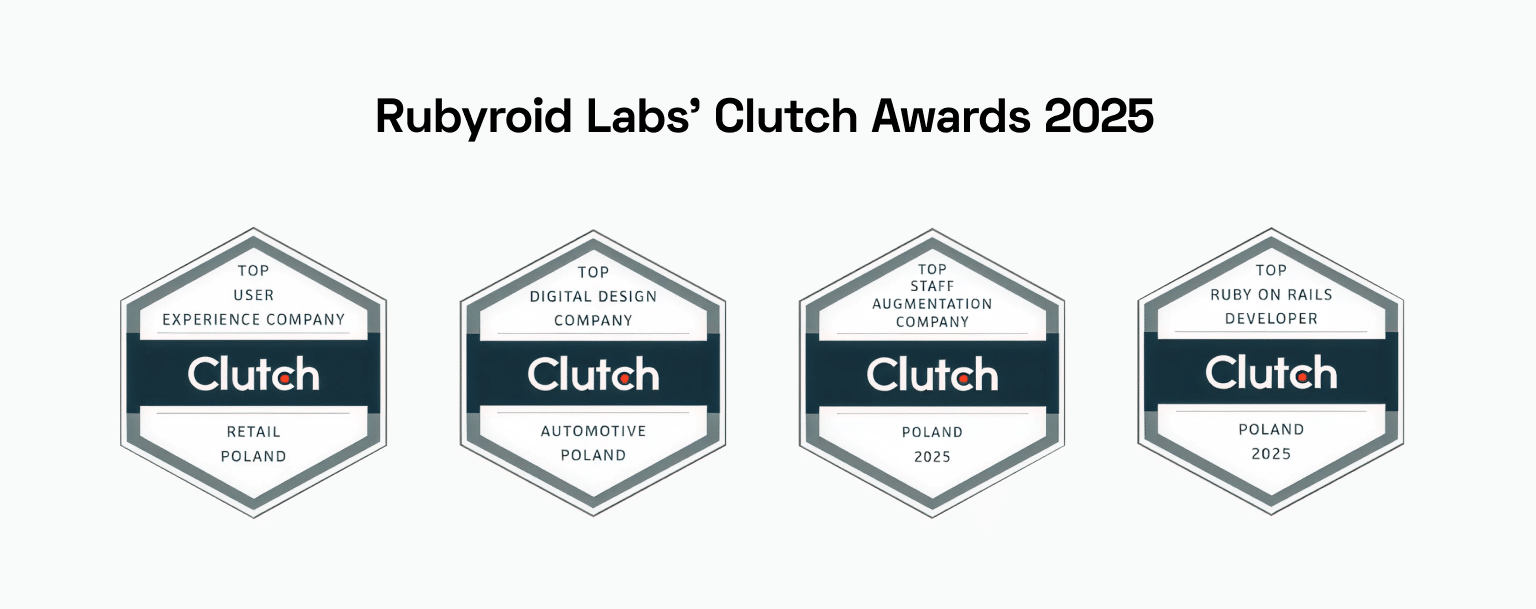
- Notable proof signals: 5.0 ⭐ on Clutch, 52+ verified reviews, and “Top Rated” on Upwork.
- Good fit if: you want a partner who acts as part of your internal team, pushing back on bad ideas to ensure product success.
- Not the best fit if: you are looking for short-term, transactional help for small, one-off tasks
2. The Gnar Company
Why choose: The Gnar Company stands out with a bold promise: a 12-month bug-free warranty on their code. They use a proprietary “Quality Software Faster” process that allows them to deploy production-ready code within the first week of engagement, bypassing the typical month-long onboarding lag.
- Best for: established companies and funded startups with “gnarly” technical challenges that need immediate senior-level intervention.
- Key services: enterprise web & mobile apps, React Native & Rails development, rapid team augmentation, AI integration.
- Engagement model: dedicated teams, embedded staff augmentation.
- Notable proof signals: 5.0 on Clutch, named “Top Software Developer in MA,” 12-month code warranty.
- Good fit if: you have a high-stakes project and need a team that hits the ground running on Day 1 (not Month 2).
- Not the best fit if: you are looking for a low-cost maintenance partner for a simple website.
3. Goji Labs
Why choose: With over $1 billion raised by their clients, they specialize in “strategy-led discovery.” They don’t just build what you ask for but rigorously validate your business model and design before writing a single line of code.
- Best for: founders and nonprofits looking to build a product specifically to raise capital or scale user adoption.
- Key services: product strategy, UX/UI design, IoT development, web & mobile app development.
- Engagement model: product discovery workshops, end-to-end development.
- Notable proof signals: 150+ products launched, clients raised $1B+, strong focus on Los Angeles & NYC markets.
- Good fit if: you need a partner who challenges your business logic and helps you pitch to investors.
- Not the best fit: if you already have a frozen spec and just need “hands-on-keyboard” developers to execute it blindly.
4. JetRockets
Why choose: JetRockets has built a reputation as the bridge for non-technical founders. They specialize in taking clients from “No-Code” prototypes to fully scalable custom Ruby on Rails applications. They prioritize “boring” (stable) technology over hype, ensuring your product is maintainable for the next 5–10 years.
- Best for: non-technical founders moving from MVP to Series A scale.
- Key services: MVP development, legacy application modernization, security audits, travel & fintech solutions.
- Engagement model: time & materials, dedicated product teams.
- Notable proof signals: 4.9 on Clutch, 50+ Verified Reviews, 12+ years on the market.
- Good fit if: you are a founder who needs a partner to explain why technical decisions are being made, not just what.
- Not the best fit if: you need a massive enterprise team of 100+ developers to start tomorrow.
5. SoftSuave
Why choose: Scalable resources for rapid expansion.
SoftSuave is a volume-focused firm designed for speed. They excel at deploying large numbers of developers quickly, making them a strong choice for companies that need to ramp up a workforce immediately without a lengthy recruitment process.
- Best for: rapidly scaling up a team when volume matters more than niche consulting.
- Key services: web & mobile app development, SaaS product development, cloud computing, legacy modernization.
- Engagement model: fixed price, time & material, dedicated team.
- Notable proof signals: 38+ Verified Reviews, 12+ years in business.
- Good fit if: you have a well-defined roadmap and just need raw coding power to execute it at a lower cost.
- Not the best fit if: you need high-level architectural consulting or a boutique, “white-glove” experience.
6. Hyperlink InfoSystem
Why choose: The enterprise giant for multi-tech ecosystems.
As one of the largest firms on this list, Hyperlink InfoSystem is a “one-stop-shop” for massive enterprises. They handle everything from AI and VR to mobile apps, making them ideal for complex projects where Rails is just one part of a larger tech stack.
- Best for: massive enterprises with diverse, multi-technology needs (AI, VR, Blockchain).
- Key services: mobile app development (Android/iOS), blockchain & metaverse, AI/ML development, web development (RoR, PHP, Python).
- Engagement model: project-based, dedicated resources.
- Notable proof signals: 171+ Verified Reviews, 4500+ Apps Developed.
- Good fit if: you are a Fortune 500 company needing a vendor who can handle a VR project, a mobile app, and a Rails backend simultaneously.
- Not the best fit if: you want a specialized, “Rails-first” culture or direct access to the agency founders.
7. Rexsoft
Why choose: Boutique attention with US-standard quality.
Rexsoft balances technical skill with a strong focus on design and user experience. They position themselves as a “boutique” studio that offers high-touch communication and polished visuals, making them effective for consumer-facing web products.
Best for: mid-market companies that need a polished, US-style design aesthetic.
Key services: custom web development, UI/UX design, CRM/ERP development, mobile app development.
Engagement model: dedicated team, project-based.
Notable proof signals: 4.9 Clutch Rating, focus on US clients.
Good fit if: visual polish and seamless user experience are just as important to you as the backend code.
Not the best fit if: you need an enterprise-grade team of 50+ developers to start immediately.
8. Emizentech
Why choose: The E-commerce specialists.
While widely known for Magento, Emizentech has a robust Ruby on Rails division focused on custom commerce. They are the go-to experts for building complex B2B marketplaces, subscription platforms, or vendor portals that off-the-shelf tools can’t support.
Best for: complex e-commerce platforms and marketplaces.
Key services: custom e-commerce development, marketplace solutions, Salesforce integration, mobile app development.
Engagement model: fixed cost, hourly, dedicated team.
Notable proof signals: 132+ Verified Reviews, 8+ years experience.
Good fit if: you are building a complex B2B marketplace or a subscription platform that requires deep commerce logic.
Not the best fit if: you are building a purely content-based or social platform with no commerce element.
9. Semidot Infotech
Why choose: The MVP sprinters.
Semidot markets itself as the “Startup’s Best Friend,” specializing in taking early-stage ideas to market quickly. Their focus on speed and affordability makes them an attractive option for bootstrapped founders needing a working MVP to validate their concept.
Best for: early-stage startups needing a cost-effective MVP.
Key services: MVP development, startup consulting, mobile apps (Flutter/React Native), web development.
Engagement model: fixed price (for MVPs), dedicated team.
Notable proof signals: 4.7 Clutch rating, strong portfolio of startup launches.
Good fit if: you are bootstrapping your first product and need to validate the idea without burning a hole in your pocket.
Not the best fit if: you need to refactor a massive, high-load enterprise legacy system.
10. Whizzbridge
Why choose: Strategic architecture for the big leagues.
Whizzbridge acts as the “architect behind the curtain” for companies that have outgrown simple MVPs. They specialize in high-load systems, focusing on serverless architecture and data engineering that can handle millions of requests without buckling.
Best for: scale-ups and enterprises needing cloud architecture overhaul (AWS/Azure).
Key services: cloud consulting (AWS/Azure), software architecture, custom RoR development, data engineering.
Engagement model: consulting retainer, dedicated engineering teams.
Notable proof signals: 5.0 on Clutch, strong US/UK presence.
Good fit if: you have an in-house team but need external experts to design your scalable cloud infrastructure.
Not the best fit if: you are looking for a simple staff augmentation solution for junior developers.
11. i-Verve
Why choose: The migration experts.
i-Verve specializes in modernizing legacy systems, particularly “Lift and Shift” projects. They have a strong track record of taking older Rails applications (versions 4 or 5) and upgrading them to modern standards safely and without downtime.
Best for: migrating old Rails apps to modern versions.
Key services: RoR upgrade & migration, enterprise web development, CRM/ERP solutions, CMS development.
Engagement model: hourly, fixed project.
Notable proof signals: 9 Verified Reviews, focus on stability.
Good fit if: you have a stable, older Rails application that needs to be modernized for security and performance.
Not the best fit if: you are a startup looking for “zero-to-one” product discovery and innovation.

Hire Ruby on Rails developers USA: 2026 checklist
You’ve seen the list. But let’s be real, hiring a development team is a lot like a marriage. The dating phase (sales calls) always looks perfect. Everyone is on their best behavior. But the truth comes out when the first server crashes on a Friday night.
In 2026, you can’t afford a “learning curve.” That’s why you need a partner who has been there, done that, and bought the t-shirt.
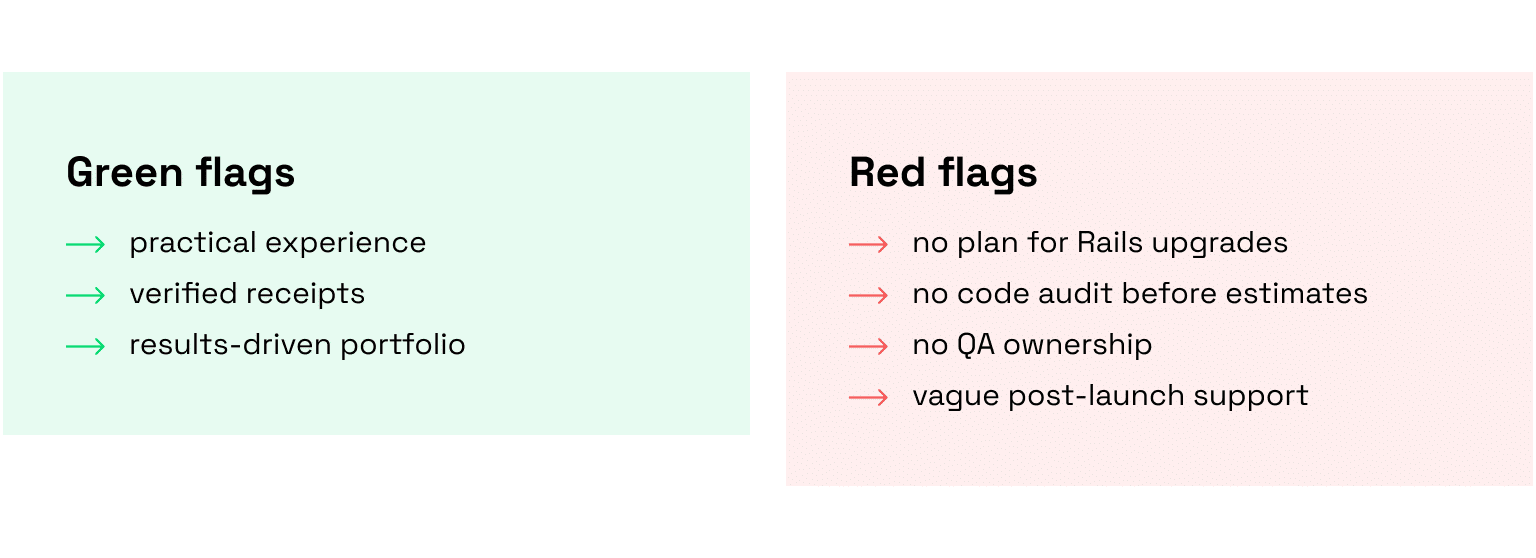
Green Flags: the “must-haves”
If a company can’t confidently check these three boxes, they aren’t ready for your business.
1. Practical experience (battle scars)
Don’t just ask, “How long have you been in business?” Ask, “What’s the worst crash you’ve ever fixed?” Theory is cheap. You want a team that has actual battle scars. A top-tier partner understands the messy reality of software like scaling databases, refactoring legacy spaghetti, and handling traffic spikes. If their portfolio is only simple landing pages, they will crumble under complex logic.
2. Verified receipts (third-party reviews)
Testimonials on a homepage are marketing. Look for verified reviews on platforms like Clutch and feedback that tell detailed stories, not just star ratings. Does the review mention specific developers by name? Do they talk about how the agency handled a crisis?
The greenest flag is a review that says, “We had a major issue, and here is how they fixed it.” Perfection is suspicious but resilience is real.
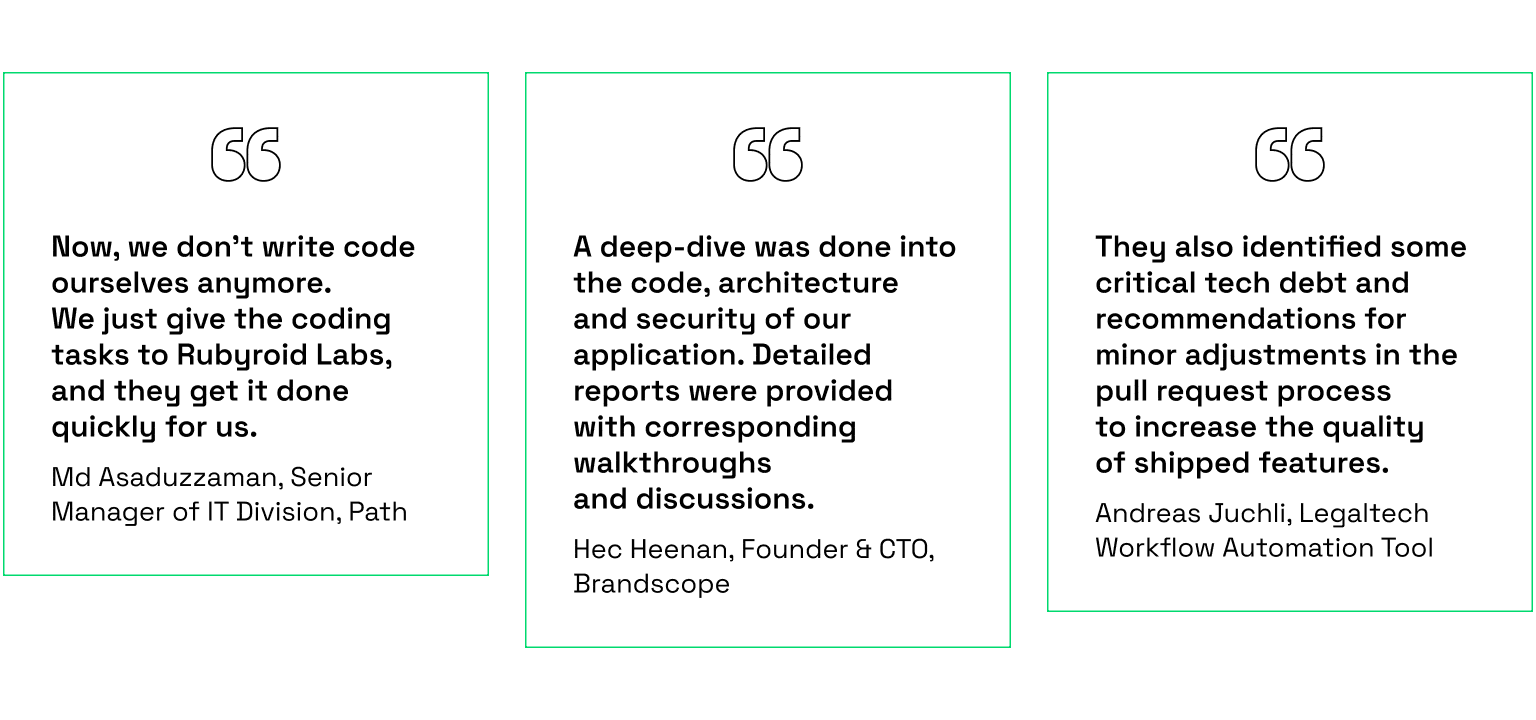
That’s why reviews that include real context matter. On the Rubyroid Labs Clutch page, clients describe specific challenges, how our team approached them, and what changed as a result, so you can judge problem-solving, not just promises.
Results-driven portfolio
Pretty screenshots are nice, but does the case study talk about business?
A good portfolio doesn’t just say, “We built an e-commerce site.” It says, “We reduced cart abandonment by 20% by refactoring the checkout flow.” Look for partners who frame their work in terms of your ROI, not just their code syntax.
Red Flags: when to run away
Sometimes, the warning signs are subtle. Even one of these should make you pause. Two or more? Keep looking.
1. No plan for Rails upgrades
If they don’t proactively discuss how they’ll keep your app current with Ruby on Rails security patches and framework evolution, you’ll be stuck on an unsupported Rails version within 18 months: vulnerable, slow, and expensive to fix later.
- Test question: “How do you handle Rails upgrades for client apps after launch?”
- Bad answer: “We can do that when needed.”
- Good answer: “We include quarterly dependency audits and stage upgrades in a rollback-safe CI/CD pipeline.”
2. No code audit before estimates
Agencies that give fixed-price quotes after a 30-minute call are guessing. Real partners audit your existing codebase (if applicable), ask hard questions about scale, and identify risks before committing to timelines.
- Test question: “What do you need from me to give an accurate estimate?”
- Bad answer: “Just send us the feature list.”
- Good answer: “We need access to your repo for a code audit, analytics data, and a technical interview with your team.”
Being also a company providing Ruby on Rails consulting services in USA, at Rubyroid Labs we offer a separate Code Audit service if you are interested in scaling but have doubts that your system needs improvements, have some performance issues or want to check the quality of code in your system.
3. No QA ownership
If their proposal treats QA as “optional” or outsources it to a third party, you’ll get bug-ridden releases. Quality partners bake testing into development like unit tests, integration tests, and automated regression testing.
- Test question: “How do you prevent bugs from reaching production?”
- Bad answer: “We test manually before launch.”
- Good answer: “Every PR requires passing RSpec tests, and we run Capybara for end-to-end flows. Here’s our CI/CD setup.”
4. Vague post-launch support
“We offer support” means nothing without specifics. What’s the SLA? Who responds? How fast? Vague promises turn into “that’ll be a separate contract” once you’re live.
- Test question: “What happens if the app crashes at 2am on a Saturday?”
- Bad answer: “We’ll get to it Monday.”
- Good answer: “Our DevOps team monitors 24/7 with PagerDuty alerts. Critical issues get a 1-hour response SLA.”
Use this checklist to find the right fit. The best Rails partners don’t hide behind jargon or disappear after deployment. They’re transparent about challenges, dedicated to solving them with you, and treat your project’s success as their own mission.
Wrapping up
If we had to summarize the state of software in 2026 in one word, it would be efficiency.
The days of spending budgets on over-engineered architectures have been replaced by shipping speed and business logic over complexity.
This is exactly why Ruby on Rails has returned to the throne. It remains the only framework designed to let a team of three do the work of thirty.
But remember: a Formula 1 car is only as fast as its driver. Rails gives you the potential for speed, but only a partner with the right “product mindset” can turn that potential into profit.
Choosing that partner is the last variable.
Whether you need the massive scale of a Hyperlink InfoSystem or the “technical co-founder” relationship that we offer at Rubyroid Labs, the key is to look for transparency. In 2026, you don’t just need a vendor who closes tickets but a partner who opens doors.