Customer support that only answers questions leaves work unfinished.
AI agents resolve issues end-to-end. They ask clarifying questions, fetch account context, propose fixes, and guide users to the next step, including product recommendations.
They do the same for analytics and personalization: detect gaps, predict outcomes, and tailor the experience from real user data.
This isn’t a ChatGPT widget bolted onto your UI. An AI agent is an autonomous system that uses your knowledge, follows your rules, and completes workflows.
Here we’ll show how we’ve implemented AI agents inside Ruby on Rails apps through our AI integration services: handling support conversations autonomously, turning analytics into predictions, and personalizing product experiences based on user context.
Contents
- What are AI Agents in the context of RoR and how they work
- AI agents for customer support in Rails
- AI agents for analytics, prediction, and personalization
- How AI agents drive users’ decisions inside a product
- 3 key challenges of AI integration in Rails and how to fix them
- How to integrate AI agents into Rails: architecture and implementation patterns
- Conclusion
What are AI Agents in the context of RoR and how they work
First-generation AI integration is straightforward: you send a prompt to an API, get a response, and display it. This works perfectly for summaries, translations, or simple Q&A.
We’ve already covered how to implement these features via LLM APIs.
But simple AI features hit limitations the moment users need anything beyond a text answer.
- “Check my order status” – a standard LLM has no bridge to your PostgreSQL database or ActiveRecord models.
- “Recommend a plan for my team” – an isolated API can’t trigger your Rails Service Objects or calculate logic defined in your domain models.
- “Find users likely to churn” – a basic chatbot can’t run background jobs or trigger system alerts.
Second-generation AI integration, which we call AI agents, solves this. Agents connect directly to your backend and perform as full-fledged junior team members. By leveraging tool-calling (function calling), they can securely query ActiveRecord, execute custom Rails methods, follow strict business rules, and take autonomous actions within the permissions you define.
The shift is architectural, not just technical.
| Traditional AI feature | AI agent |
| Responds to single, specific requests | Handles multi-step workflows autonomously |
| Requires exact input format | Understands intent from natural language |
| Returns data or predictions | Takes actions and moves workflows forward |
| Operates in isolation | Connects across systems and data sources |
| Needs human intervention for edge cases | Reasons through problems and adapts |
| Lower upfront cost, higher ongoing manual work | Higher upfront build, lower cost per workflow at scale |
The industry is also shifting from single AI agents to Multi-Agent Systems (MAS), where specialized agents collaborate on complex workflows instead of one agent trying to handle everything. Rails’ architectural strengths make it an effective orchestrator for coordinating multiple AI agents within a single application.
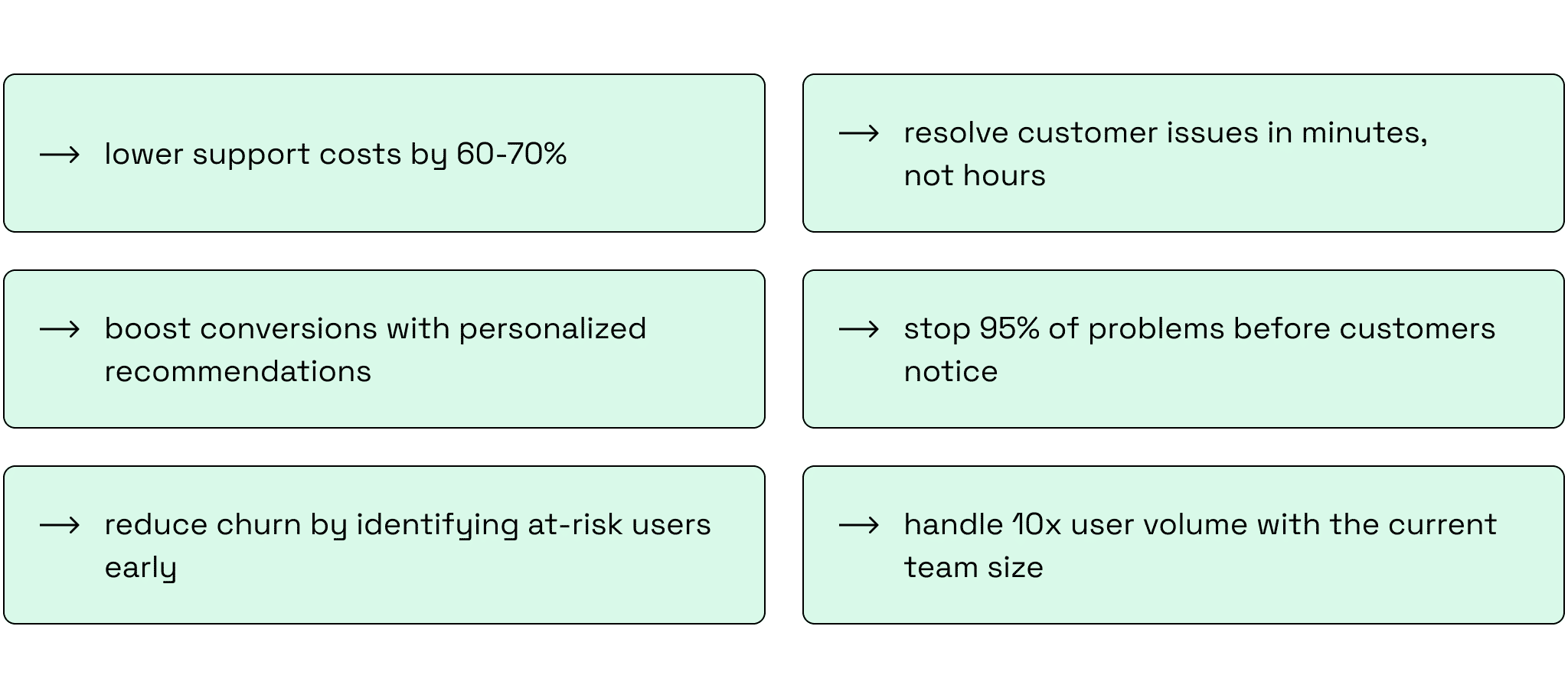
Benefits of integrating AI agents in web apps
Why Ruby on Rails is a strong framework for integrating AI
Rails excels at what agents need most: shipping complex workflows quickly and connecting systems reliably. Its clean architecture lets you encapsulate agent logic within Service Objects and manage long-running LLM tasks via robust background processing like Solid Queue or Sidekiq, all without creating messy code.
While mature gems handle the API layer, Rails goes much further: ActiveRecord (paired with vector extensions like pgvector) provides secure, clean database access for giving AI context, and Hotwire / ActionCable allows you to stream agent responses to the UI in real-time.
More importantly, Rails’ stability matters when adding autonomous systems that interact with customer data. You need predictable behavior, strict data validation, and maintainable code to keep AI safe in production.
That’s what our Ruby on Rails development services deliver: AI-integrated systems that handle thousands of conversations, process complex documents, and make autonomous decisions reliably and securely.

AI agents for customer support in Rails
According to customer support statistics, teams spend 75% of their time on repetitive tasks, with only 25% spent on complex, high-value work. This leads to frequent team burnout on one side and disappointing business results on the other, such as longer response times, lower satisfaction scores, and scaling challenges as you grow.
AI integration in Ruby on Rails apps automates routine questions, checking order status, explaining features, and finding policy details by accessing your database and documentation directly. Instead of generic chatbot scripts, users get accurate answers grounded in your actual business data. Your team stops being a search engine and starts solving real problems.
Real-world success: insurance platform AI transformation
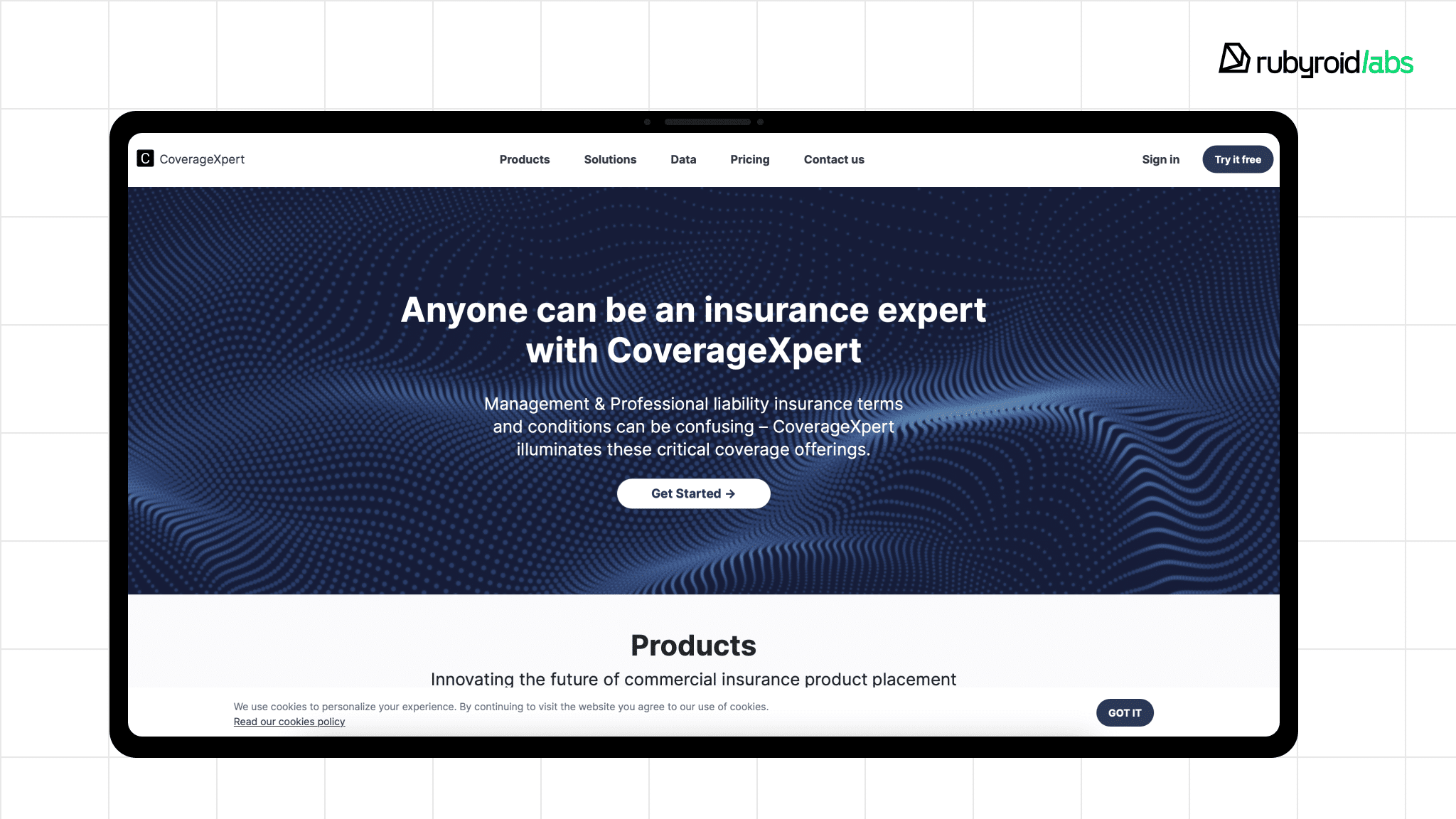
CoverageXpert is a database of management and professional liability insurance policies with over 700 policy forms and 33,000 coverage enhancements from 50 carriers.
The problem: As the insurance database grew, working with massive data volumes became increasingly difficult for brokers.
We integrated a two-agent system into Rails:
- The Researcher (ChatGPT Integration): We built a custom Rails service that indexes proprietary insurance data. When a user asks a question, this agent queries the database via ActiveRecord, retrieves the relevant policy sections, and provides a natural language answer with direct citations.
- The Auditor (Gemini Integration): We implemented a second agent focused on “reasoning.” It takes the extracted data and compares it against industry benchmarks to autonomously flag missing endorsements or coverage risks that a human might overlook.
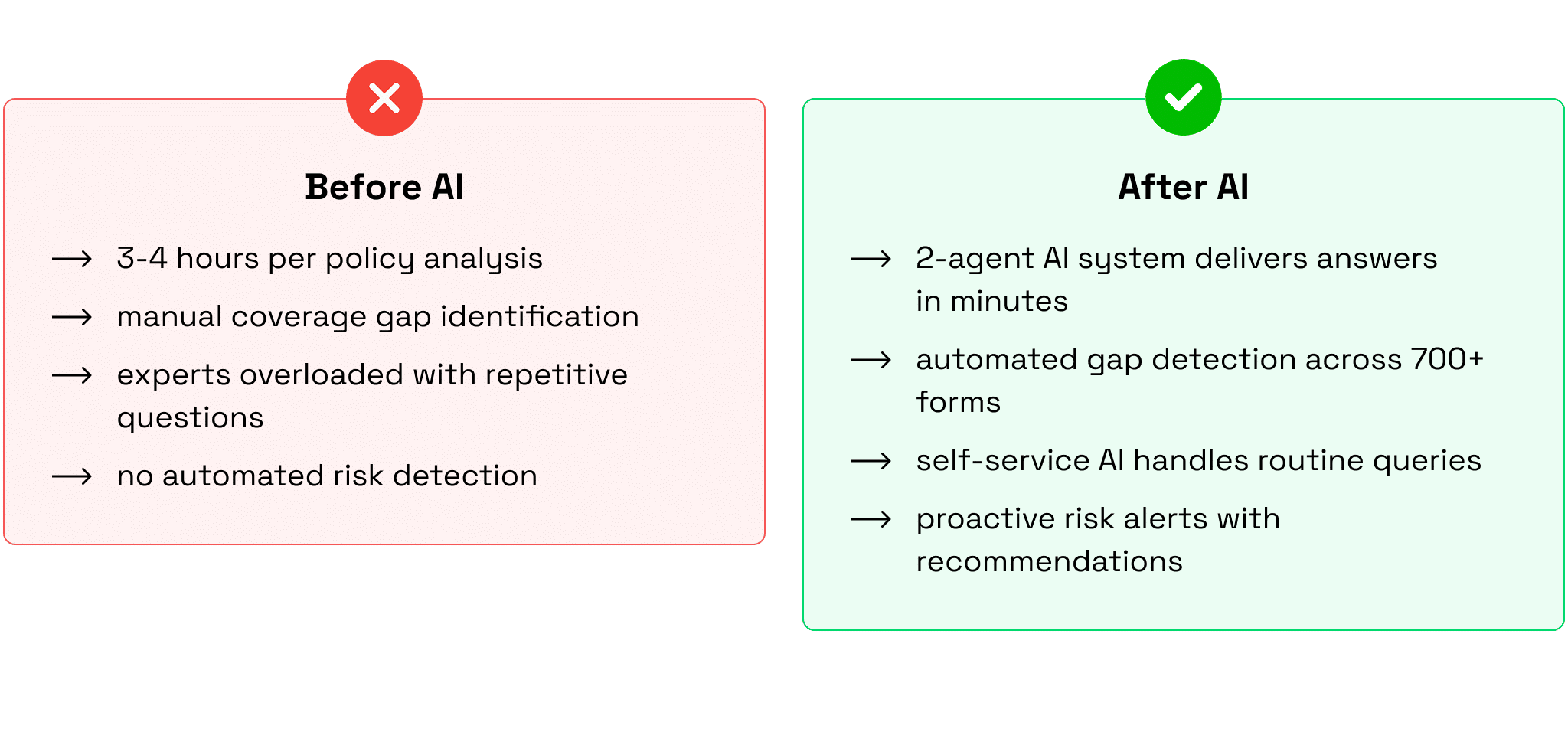
The result: Insurance agents stopped doing repetitive manual research and started focusing on strategic client relationships.
This same model will also work for your Rails app, if:
- your users manually search through complex data
- your team answers repetitive technical questions
- domain expertise is locked in human brains instead of accessible through your platform.
AI agents for analytics, prediction, and personalization
In a Ruby on Rails application, data is often your most valuable and most underutilized asset. Integration of AI agents allows you to move from “reporting” what happened yesterday to “predicting” what will happen tomorrow. By sitting directly on top of your Postgres or NoSQL databases, these agents identify patterns in user behavior, anticipate churn, and personalize the UI in real-time.
Traditional analytics tell you that a user clicked a button. An AI agent tells you why they clicked it and what they are likely to do next.
Case-study: AI integration in Ruby on Rails for personalized training
NNOXX created an innovative wearable biosensor that measures muscle oxygenation (SmO₂) and nitric oxide (NO) levels during workouts. Used by top US sports leagues including the NBA, MLB, NHL, and NFL, the device provides real-time physiological data that traditional fitness trackers can’t capture.
The problem: the client’s key need was a smart app that could collect, analyze, and interpret the raw data.
We integrated AI to transform raw biometric data into actionable coaching with predictive injury risk based on overtraining patterns, personalized workout intensity recommendations, and real-time optimization with immediate feedback on when to push or ease off.
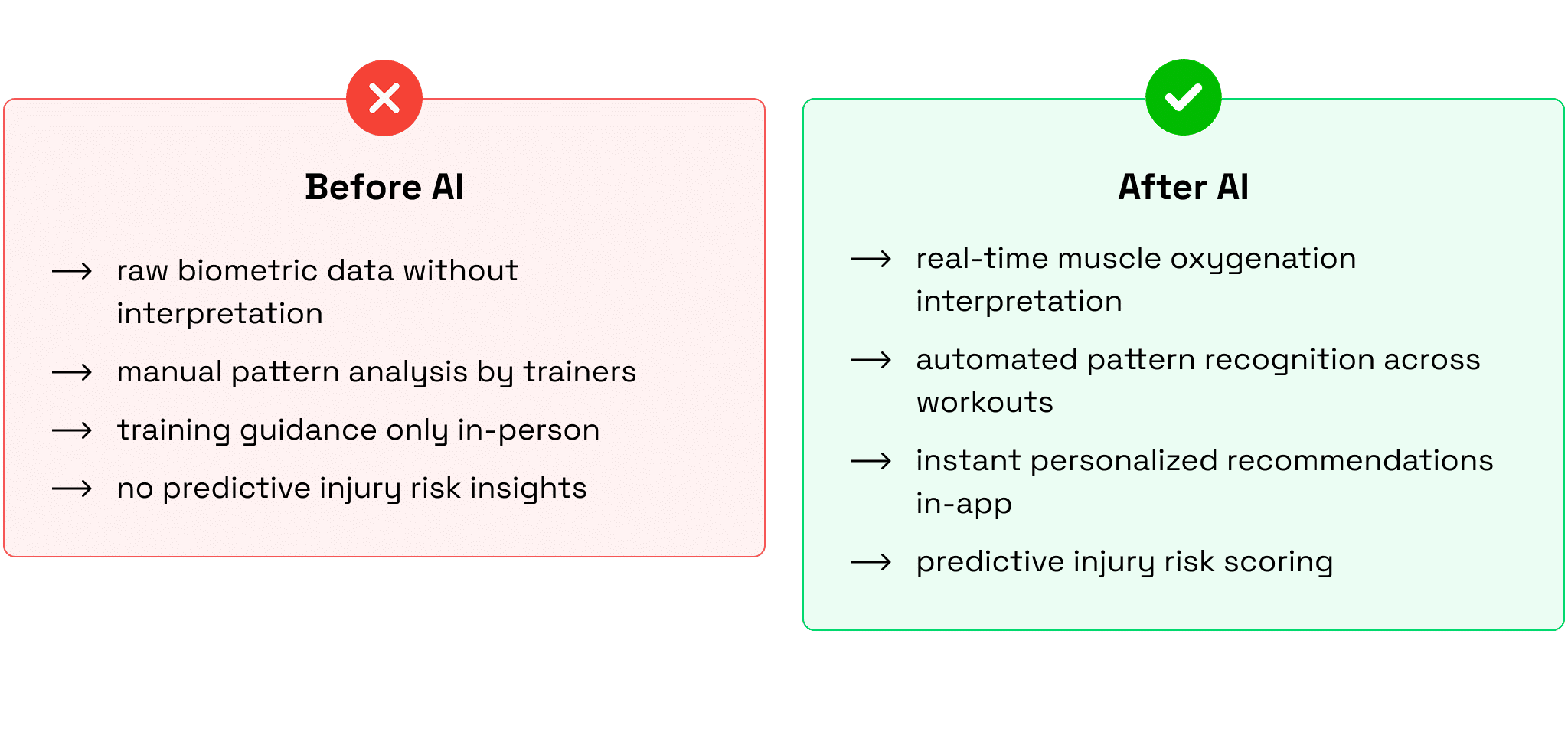
The result: First platform delivering AI-powered training guidance from real-time muscle physiology. Professional teams minimize injuries while maximizing performance.
Working with raw data, AI agents transform it into personalized insights that help your customers achieve better results. You gain a stronger reputation, higher user engagement, and access to new markets.
How AI agents drive users’ decisions inside a product
In a Ruby on Rails application, user data is often your most valuable yet underutilized asset. Integration of AI agents shifts your platform from passively recording what happened to actively guiding what happens next. Instead of presenting users with overwhelming options, AI analyzes context and steers them toward the right choice.
Traditional product features present options.
AI agents understand context and guide users to the best decision for their specific situation.
Case Study: AI-driven decision-making in Rails app for bike fitting
Myvelofit is a subscription platform that helps cyclists find the best-fitting bikes for healthy, comfortable rides. Used by riders and sports businesses across 100+ countries, it provides detailed geometry recommendations and personalized posture adjustments.
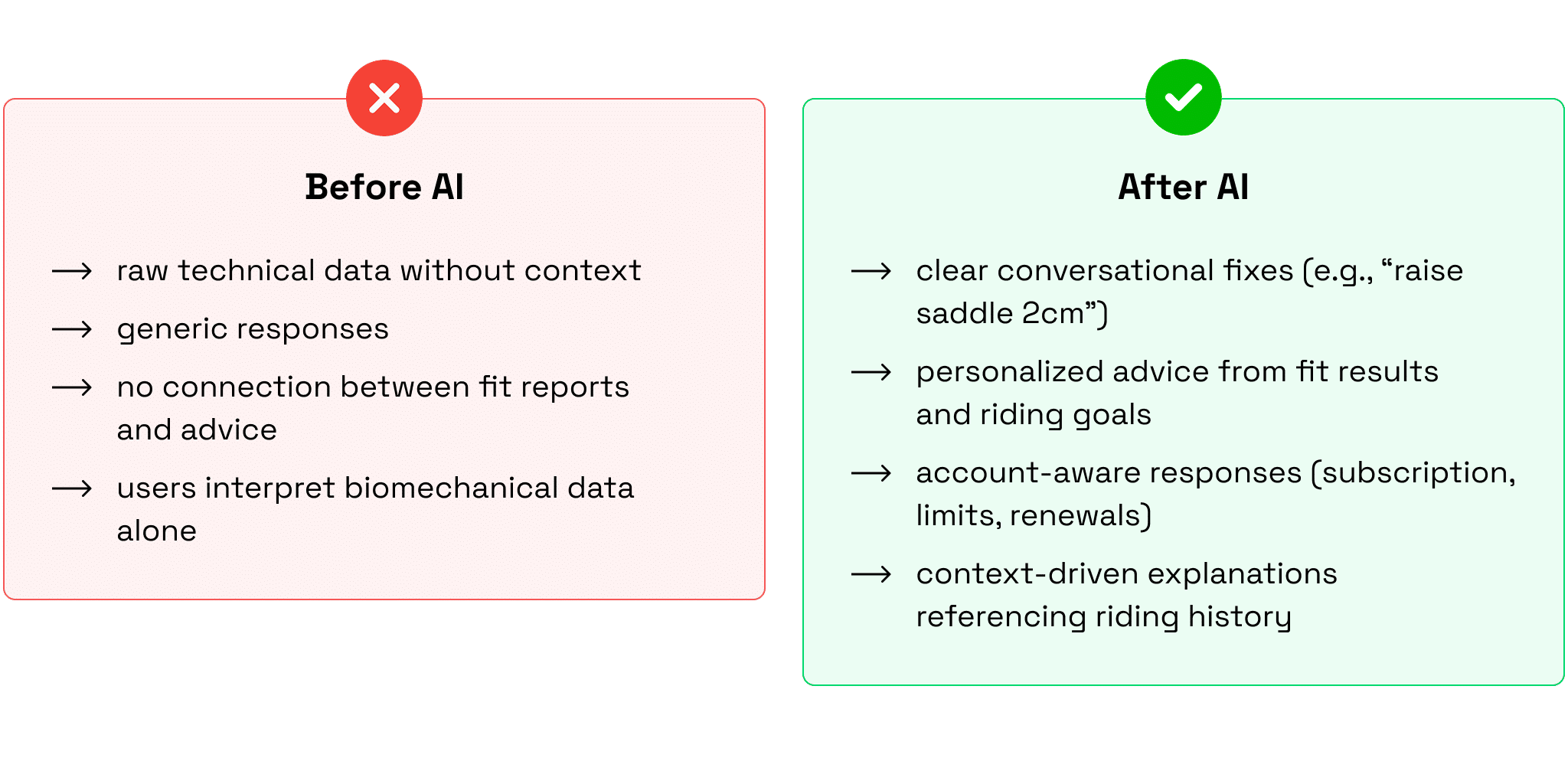
The problem: While Myvelofit’s AI already analyzed photos and videos to generate fit reports, users struggled to interpret complex technical data like joint angles, ranges, and recommendations. They needed expert guidance to understand what bike they should buy and what adjustments to make without booking expensive consultations.
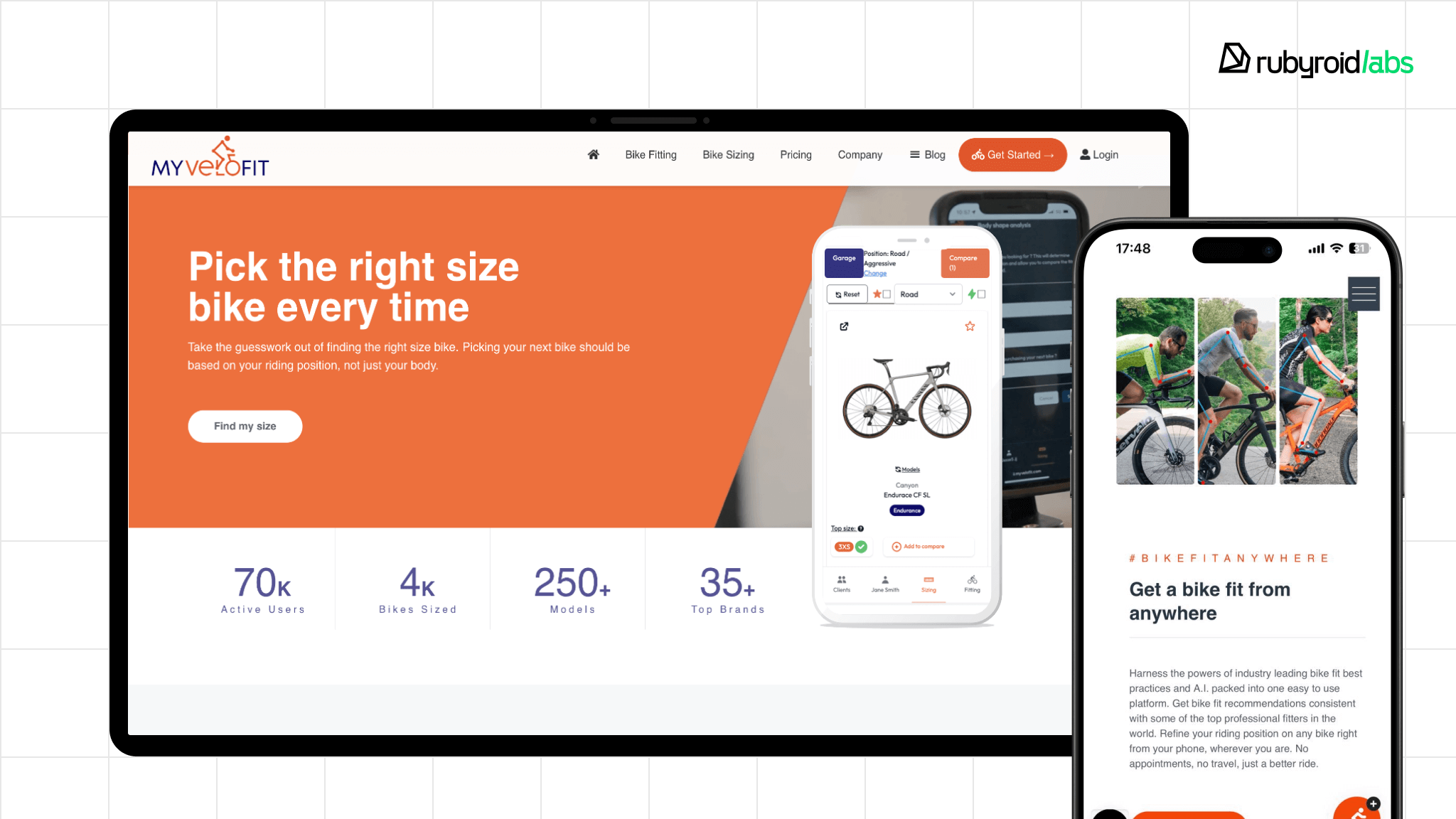
We integrated an OpenAI Assistant as a personal bike fit consultant. Through function calling, it retrieves user data such as fit results, joint angles, and mobility assessments and delivers personalized advice: “Your knee angle is 28°, your range is 35-40°.” It also handles account queries like renewals and upload limits.
The result: Expert-level bike fitting guidance through conversation. Users select bikes for purchase fitted to their body and lifestyle and optimize their position on existing bikes for healthier, safer rides with no technical expertise or professional fitter needed.
3 key challenges of AI integration in Rails and how to fix them
Integrating an AI agent into a Rails app is the easy part. What’s harder is turning it into something that scales beyond a pilot: reliable with your data, fast for real users, and maintainable by your team.
IBM reports that only 16% of AI initiatives scale across the enterprise, and MIT’s NANDA study suggests that up to 95% of genAI pilots stall in experimentation.
In our experience, this gap is caused by three production constraints. Here is how we overcome them to turn your AI into a dependable product capability.
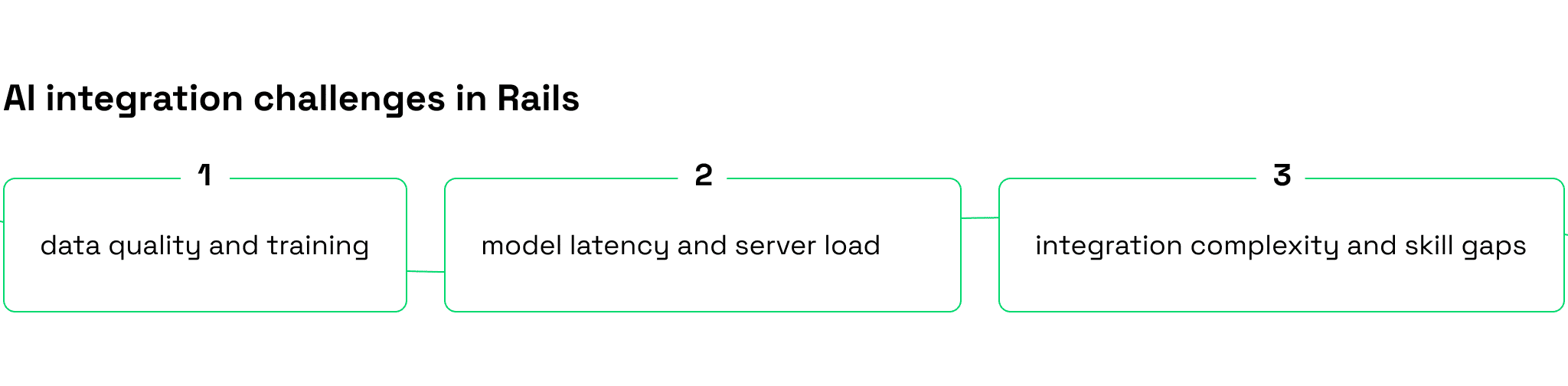
1. Data quality & “hallucinations”
The risk: If an AI is fed raw, unstructured database information, it will “guess” the answers. This leads to hallucinations, which are plausible but entirely incorrect answers that can damage your brand or mislead customers.
Our fix: We implement Retrieval-Augmented Generation (RAG) tied directly to your verified database. By utilizing vector search (pgvector) integrated with ActiveRecord, we ground every AI response in factual, real-time context before the model even generates a word.
The result:
- Grounded accuracy: Your agent doesn’t invent pricing, policies, or features. It acts as a strict, verified source of truth.
- Zero brand risk: You can safely put the AI in front of enterprise clients knowing it will only answer based on the documentation you approve.
- Context-Aware: Because the RAG is scoped to your Rails models, the AI only “retrieves” information the current user is authorized to access.
2. Model latency & runaway API costs
The risk: LLM APIs (like OpenAI or Anthropic) are slow. If poorly integrated, an AI agent will freeze your app’s loading screens, cause server timeouts, and generate unpredictable, spiking API bills.
Our fix: We move beyond basic background jobs by implementing Semantic Caching (using vector similarity to reuse previous answers for related queries) and Real-Time Streaming (via Turbo Streams) so the UI updates instantly. We also enforce strict token budgets and use Circuit Breakers to decouple the AI’s uptime from your core app.
The result:
- Instant user experience: Your users get a snappy, conversational “typing” effect rather than staring at a loading spinner for 10 seconds.
- Predictable infrastructure costs: By caching responses and enforcing strict token budgets, we prevent runaway API bills, even if user traffic spikes 10x.
- System Resilience: If an AI provider suffers an outage, your Rails application remains fully operational, gracefully handling the failure rather than crashing.
3. Integration complexity & security gaps
The risk: AI tools often bypass standard app permissions. If an agent isn’t strictly bounded, it might accidentally expose sensitive data from User A to User B. Furthermore, complex AI code can become a “black box” that your normal developers don’t know how to fix.
Our fix: We build strict execution boundaries using the Model Context Protocol (MCP) and encapsulate all AI logic into standard Rails Service Objects. The AI only gets access to whitelisted tools with strict authorization checks.
The result:
- Enterprise-grade security: The AI is strictly bounded by your existing Rails authorization rules (like Pundit or CanCanCan). It is architecturally isolated to prevent cross-tenant data leaks.
- No vendor lock-in: Because the AI logic is modular, if a better or cheaper AI model comes out tomorrow, we can swap it out in hours without rewriting your app.
- Standardized handoff: Your existing Rails team can easily maintain, test, and update the application without you needing to hire expensive Machine Learning specialists.
The gap between a stalled pilot and a profitable AI agent comes down to execution. By addressing data quality, latency, and security head-on, we transform AI from a fragile experiment into rock-solid product infrastructure. We don’t just build flashy prototypes but build dependable Rails systems that scale with your users and deliver measurable business value.
How to integrate AI agents into Rails: architecture and implementation patterns
Integrating an AI agent means architecting a system that feels native to the Ruby on Rails philosophy. To build AI agents in web applications that are maintainable and scalable, we follow specific design patterns that separate concerns:
AI models generate decisions and content (“AI thinking”), while Rails handles data access, business logic, and user interactions (“Rails doing”).
Here is how to integrate AI agents into Ruby on Rails applications using the five core patterns we use to bring autonomous intelligence into the RoR ecosystem:
Core integration patterns
| Pattern | Description | Key tech Rails gems |
| Agent-as-a-Service | Orchestrating LLMs, vector search (RAG), and context memory inside decoupled Service Objects. | langchainrb, neighbor (pgvector), ruby-openai / anthropic-sdk-ruby, custom Faraday middleware |
| Tool & Function Calling | Defining strict execution boundaries, input schema validation, and secure context injection for LLM tool use. | fast-mcp, json_schemer (for JSON Schema), active_model (for type casting) |
| Real-Time Streaming | Parsing chunked Server-Sent Events (SSE) and rendering partial Markdown via WebSockets without DOM thrashing. | ActionCable, Turbo Streams |
| Asynchronous Jobs | Managing long-running agent loops with circuit breakers, exponential backoff for API 429s, and webhook callbacks. | Solid Queue, Sidekiq, circuitbox / stoplight |
| Stateful Orchestration | Persisting execution graphs, managing Human-in-the-Loop (HITL) checkpoints, and auditing token usage. | AASM, noticed (for HITL alerts), Postgres JSONB |
1. Agent-as-a-Service (Orchestration & RAG)
Don’t clutter your User model with basic API calls. Building an agent requires orchestrating memory, retrieving context, and handling rate limits. We encapsulate this logic within dedicated Agents or Service Objects using frameworks like langchainrb and integrate vector search directly into ActiveRecord using the neighbor gem (pgvector). We also build custom Faraday middleware to handle token tracking, retries, and provider fallbacks automatically, ensuring your app isn’t tightly coupled to a single AI provider’s uptime.
2. Tool/Function calling (The “Action” layer)
Giving an AI access to your database is dangerous if done poorly. We don’t just expose methods; we build strict execution boundaries. Using the Model Context Protocol (MCP) or gems like openai-toolable, we define exactly what the LLM can do and validate its arguments against a JSON Schema before any Ruby code executes. This ensures that the AI stays within its sandbox and only interacts with the specific resources it is authorized to see.
Here is an example of how we safely expose a Rails method to an AI agent, ensuring strict parameter typing:
Ruby
# app/services/ai/support_agent.rb
module AI
class SupportAgent
include OpenaiToolable # or fast-mcp integration

def initialize(current_user)
@current_user = current_user
end

# Define a strict boundary and JSON Schema for the LLM
openai_tool :check_order_status, description: "Check the status of a specific order" do |p|
p.add :order_id, type: :string, pattern: "^ORD\\d{3}$", required: true
end

def check_order_status(order_id:)
# Security: Scope the query to the current user to prevent data leaks
order = @current_user.orders.find_by(number: order_id)

order ? "Order status: #{order.status}" : "Order not found or access denied."
end
end
end
3. Real-time streaming
Users hate waiting 10 seconds for a response. However, streaming AI outputs isn’t as simple as pushing text. We use Turbo Streams and ActionCable to broadcast chunks of data as they arrive from the AI provider.
Instead of waiting for the full generation, we stream raw text fragments and use a lightweight client-side stimulus controller to append and render the final Markdown. This provides that familiar typing effect without thrashing the user’s browser:
Ruby
# Inside a Rails background job or streaming controller
client.chat(
  parameters: {
    model: "gpt-5.4",
    messages: [{ role: "user", content: "Analyze my insurance policy." }],
    stream: proc do |chunk, _bytesize|
      # Extract the token from the stream
      content = chunk.dig("choices", 0, "delta", "content")
      next unless content

      # Broadcast directly to the user's active session via Turbo
      Turbo::StreamsChannel.broadcast_append_to(
        "chat_#{@chat.id}",
        target: "message_#{@message.id}",
        html: render_partial_markdown(content)
      )
    end
  }
)
4. Asynchronous processing
Complex multi-step agents can run for 30+ seconds. We offload these to Solid Queue (the Rails 8 default) or Sidekiq, but we add enterprise safeguards.
AI APIs frequently hit rate limits (HTTP 429), so we use exponential backoff for small hiccups. For systemic outages, we wrap our background jobs in Circuit Breakers (using gems like stoplight). If an AI provider goes down, our system “trips the wire,” pausing the queue instead of infinitely retrying and burning through your server’s resources.
5. Stateful orchestration
When an agent is analyzing a complex multi-step workflow, it needs to “remember” its thought process. We use AASM (State Machines) combined with Postgres JSONB to persist the agent’s and conversation memory. This allows for Human-in-the-Loop (HITL) workflows: the agent can pause its job, alert an admin via the notification gem for approval, and resume exactly where it left off. It also creates a permanent audit trail of why an AI made a decision, which is mandatory for enterprise SaaS compliance.
By following these patterns, we ensure your AI integration works like the rest of your Rails app: testable, secure, and built to scale.
Conclusion
AI agents transform Rails applications from passive interfaces into autonomous systems that execute complete workflows. The three case studies demonstrate this in practice:
- CoverageXpert reduced policy analysis from 3-4 hours to minutes by building a two-agent system that queries 700+ insurance forms and 33,000 coverage enhancements, automatically flagging gaps brokers would miss manually.
- NNOXX turned raw biometric data into predictive injury prevention for professional athletes in the NBA, MLB, NHL, and NFL. The AI analyzes muscle oxygenation patterns in real-time and delivers personalized training recommendations that prevent overtraining injuries.
- MyVeloFit replicates expert bike fitter knowledge for 225,000+ users across 100+ countries through conversational AI that identifies positioning issues, and provides precise measurements with explanations, eliminating the need for in-person appointments.
When you architect AI agents as production Rails services with proper data preparation, background orchestration, and stateful management, they handle workflows your team currently does manually.
Your Rails app is already a powerful tool. Now, it’s time to upgrade it into your most productive team member. Bring us your most expensive manual process, and we’ll engineer an agent to handle it flawlessly.