RoR vs Node.js vs Go in 2026: why we still choose Rails

It’s true that Go outperforms Node.js and Ruby on Rails in raw throughput and latency tests. But that metric alone doesn’t reflect the broader economic picture. To choose a stack it’s necessary to evaluate technology through a more holistic lens that encompasses external dependencies, infrastructure resource utilization, talent market dynamics, and productivity metrics.
We will dissect each of these operational vectors to demonstrate why, for a significant segment of modern businesses, the stability, velocity, and mature ecosystem of Ruby on Rails continue to represent a strategically sound investment.
RoR vs Node.js vs Go 2026: how to interpret ecosystem trends
Node.js dominates in terms of adoption. According to the 2025 Stack Overflow Developer Survey, it is used by nearly 50% of professional developers. Node.js grew alongside modern frontend development, and its alignment with JavaScript and TypeScript made it the default choice for teams looking to move with a unified stack.
But this early advantage comes with an interesting pattern. As products evolve, so do expectations from the backend. It is not uncommon to see mature Node.js systems gradually offload critical parts of their infrastructure to other technologies, particularly Go.
Go (Golang), by contrast, continues to grow steadily, now used by 17.4% of professional developers, with the majority being seasoned engineers. It has solidified its position as the industry standard for cloud-native applications development and high-performance microservices.
Ruby on Rails, represents a smaller share at around 6.2%, but occupies a very stable niche. Its strongest presence remains in the US and European markets, and notably, its adoption among beginners is minimal. Over time, Rails has evolved into a “senior” technology predominantly used for building complex, business-logic-heavy systems.
Why popularity alone shouldn’t guide your choice
Popularity rarely reflects suitability. More often, it reflects low barriers to entry.
Ecosystems with low entry barriers naturally attract a large number of junior developers. In the case of Node.js, this has shaped the talent pool in a very particular way.
There is no shortage of candidates, but there is a noticeable gap when it comes to architectural experience. This is less a flaw and more an inevitable outcome of the technology’s flexibility. Without strong conventions, teams are responsible for defining their own structure, and not every developer is equally prepared for that responsibility.
That said, experienced Node.js engineers can build highly scalable and maintainable systems. The key factor is the quality of technical screening, which we at Rubyroid Labs have mastered across stacks.
Ecosystem volatility is another frequently overlooked factor. In rapidly shifting environments, tools and best practices can lose relevance so quickly that a modern stack becomes “legacy” in as little as two years. Timely, regular version updates are a necessary procedure, but you need to consider whether your situation allows you to spend 20% of your time just maintaining the status quo.
Furthermore, by choosing the most popular stack, you are competing for talent against global tech giants and high-growth startups. This increases pressure on salaries and extends hiring timelines, especially when your goal is to build a strong, senior team.
By contrast, ecosystems like Ruby on Rails or Go offer more specialized talent pools. Engineers in these spaces are often more experienced and less prone to “tooling fatigue”. This maturity is particularly valuable when considering AI adoption.
More and more companies explore automation, so the structure of the underlying system starts to matter as much as raw performance. Deploying AI agents that interact with business data requires a predictable and well-organized environment.
Rails, with its convention-driven architecture, naturally supports this need, while Node.js and Go offer the granular control over performance necessary for data orchestration at scale.

Core technical differences between RoR, Node.js, and Go
Let’s look at each technology through the lens of its core technical characteristics and the trade-offs they introduce during development.
Node.js
The main argument for Node.js web development is language uniformity. Using JavaScript/TypeScript on frontend as well as on backend allows you to move developers between layers without retraining.
Node.js also excels at real-time use cases (chat, live updates, streaming) thanks to its event-driven architecture. However, Node.js itself is a runtime, so architecture largely depends on the frameworks and conventions chosen by the team.
Lightweight options like Express provide significant flexibility but impose little structure. More opinionated frameworks such as NestJS introduce stronger architectural conventions at the cost of a higher learning curve and increased complexity.
The npm ecosystem offers immense choice, but at a cost. Dependency churn is high, and poorly maintained packages are quite frequent. It’s common for engineers to spend significant time resolving incompatible API changes or auditing libraries for stability. Asynchronous issues also require careful monitoring, otherwise, debugging can consume a disproportionate share of development time.
From an infrastructure perspective, Node.js applications are relatively light, they typically use 50–150 MB of memory per instance. This keeps hosting costs moderate for high‑concurrency workloads.
Golang
If raw efficiency is the primary criterion, Go programming language is the clear leader. For equivalent workloads, Go typically requires 50–70% less compute resources than interpreted languages like Ruby. A single Go application can handle thousands of concurrent requests on modest hardware.
Go’s concurrency model, goroutines, allows developers to spawn thousands of concurrent operations without the memory overhead of thread‑heavy architectures.
For API gateways, proxy services, or any system with high parallel throughput, Go is difficult to outperform. For teams building such systems, our Golang development services provide the necessary expertise for speed and scalability.
Importantly, Go evolves very slowly, but this is not a drawback for enterprises. The language avoids breaking changes and keeps dependencies minimal. Once a Go service is stable, maintenance effort remains low for years.
The drawback is development speed. Go is more verbose and offers less metaprogramming than Ruby. Building complex business logic with many database interactions takes longer. This extra development time may not be justified for applications that are not performance‑bound: typical internal tools, CRUD interfaces, or e‑commerce backends.
Ruby on Rails
Rails is often positioned as the slowest of the three. In raw benchmark terms, that is accurate. An interpreted language with a full‑stack MVC framework typically consumes 250–400 MB of memory per worker process, and this can scale to several gigabytes under heavy load. Compared to Go, Rails requires larger cloud instances for equivalent traffic.
However, performance is just one variable among many. In most business apps, CPU or memory is rarely the limiting factor.
Rails provides a comprehensive, opinionated structure. Because its conventions are universal, models, controllers, and services reside in predictable locations. This allows new developers to onboard within days and enables external auditors to quickly trace business logic, routing, and data flow.
In contrast, less opinionated ecosystems like Node.js or Go often define architecture ad hoc, requiring significantly more effort to audit or navigate a maturing codebase.
Rails 8 has made meaningful progress on the operational side. The framework now includes production‑ready support for PostgreSQL/MySQL and simplified zero‑downtime deployments via Kamal. Small development teams can manage complex applications without dedicated DevOps resources. Check our guide on Rails 8 & Rails 8.1 features.
Performance has also improved. The YJIT compiler delivers a 15–25% speedup for typical Rails applications. This does not close the gap with Go, but it makes Rails far more competitive in memory efficiency than it was five years ago.
The real value of Rails is its speed of change. When requirements shift, well‑structured Rails applications can easily adapt without complexity. For those who prioritize feature velocity and long‑term maintainability over peak throughput, Rails is a cost‑effective choice.
Why focusing on a single metric leads to the wrong decision
Teams optimize for what is easiest to measure: performance benchmarks, memory usage, or short-term development speed. But it is rare for products to fail because of a single weak metric. A more important factor is how different characteristics interact with your needs.
A system that is highly performant but slow to develop → can delay market entry and increase opportunity cost.
A highly flexible stack → can accelerate early progress, but gradually introduce architectural entropy that slows the team down.
A highly structured framework → may limit certain edge-case optimizations, but significantly improves consistency and long-term maintainability.
From this, we conclude: no single technical characteristic is sufficient on its own to determine the right choice.
You should understand how these characteristics interact with your business priorities:
- how quickly the product needs to reach the market;
- how much the requirements are expected to change;
- how complex the system will become over time;
- what level of engineering discipline the team can realistically sustain.
Each of these has a direct economic impact, so let us now move from technical metrics to that perspective.

Which backend is fastest to build MVP
Discussions of development speed are often reduced to coding velocity. In practice, time to market is shaped by a combination of factors, among them:
- how quickly a team can align on architecture;
- the volume of boilerplate code required.
Node.js offers strong development velocity at the team level, particularly for companies already working with JavaScript or TypeScript. Sharing types, validation logic, and utilities between frontend and backend can reduce duplication and speed up implementation.
However, this advantage is offset at the early stage. Unlike opinionated frameworks, Node.js requires teams to assemble their own stack: choosing between Express, NestJS, or Fastify, selecting an ORM such as Prisma or TypeORM, and defining architectural conventions from scratch.
According to multiple industry surveys (including State of JavaScript 2025), teams report spending a significant portion of early development time on tooling and architectural decisions rather than feature delivery.
Go is rarely chosen for speed of prototyping, but its position has evolved.
Traditionally, Go required more manual setup due to its minimalistic philosophy and lack of full-stack development frameworks. Even today, building user-facing applications with complex business logic tends to take longer compared to higher-level frameworks.
That said, two factors have changed the equation.
First, AI-assisted development has significantly reduced the time of writing boilerplate code (one of Go’s historical disadvantages). Second, Go’s simplicity eliminates much of the architectural ambiguity seen in more flexible ecosystems.
As a result, Go performs differently depending on the phase:
- Initial prototype (UI + business logic) → slower than Node.js and Rails.
- Stabilizing and preparing for production → faster, due to simple builds and deployment (single binary, minimal dependencies).
In other words, Go trades early speed for predictability later in the lifecycle.
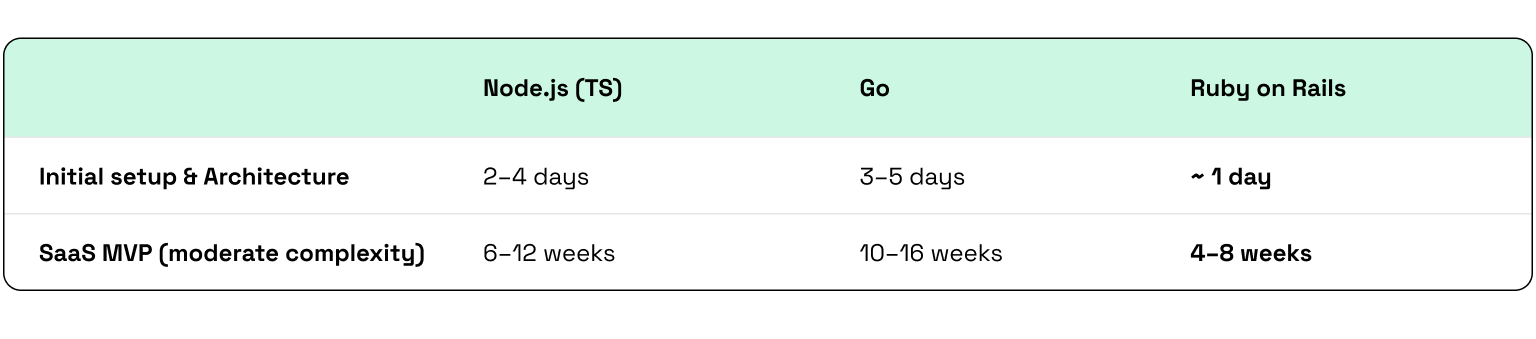
Ruby on Rails software provides established conventions for data modeling, business logic, and UI structure. This has a measurable impact on time to market.
Based on our experience in providing Ruby on Rails development services, Rails consistently enables faster delivery for products with relational data models and complex business workflows, which covers the majority of SaaS platforms, marketplaces, and internal systems.
Rails 8 strengthens this advantage further. Built-in Solid Cache, Solid Queue, and Solid Cable components eliminate the need for external infrastructure in early stages, so there’s no need to set up Redis, background workers, or additional messaging layers.
More importantly, Rails compresses not just development time, but decision time. Widely used features (authentication, admin panels, payment integrations, etc.) are supported by gems — mature, well-documented libraries.
This is where Rails often outperforms more “flexible” or “efficient” stacks.
How easy and cost-effective is hiring for each stack?
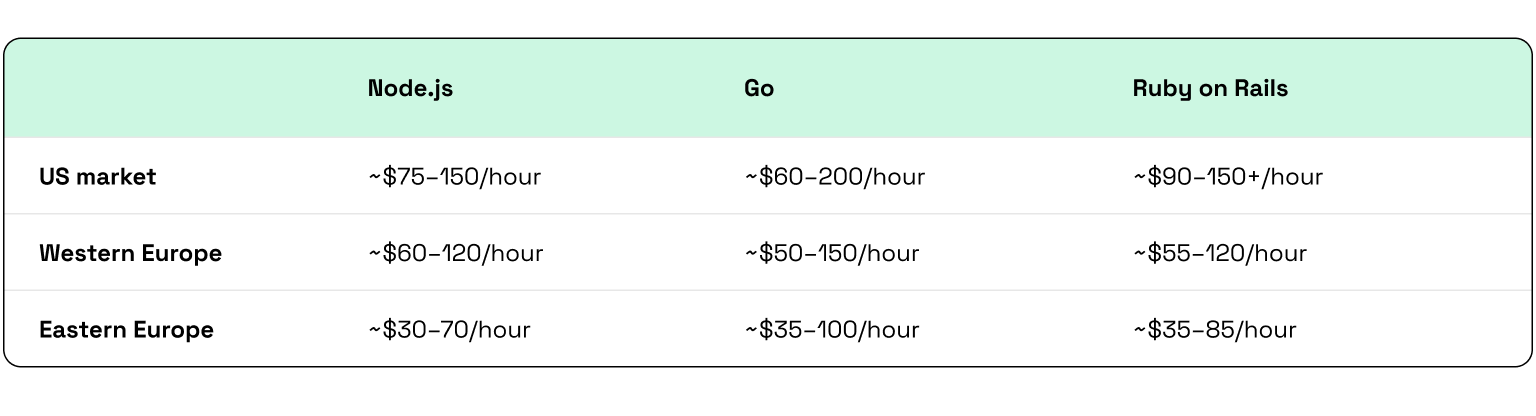
Node.js has the broadest talent pool because it captures nearly every developer who understands frontend JavaScript. If a developer leaves, a replacement can be found quickly. However, this wide choice complicates finding a developer who understands deep architecture, rather than just syntax.
In practice, this also leads to:
- more time spent on code reviews and architecture alignment;
- higher variability in delivery speed between developers.
The Go talent pool is significantly smaller, but more homogeneous in terms of seniority. Most Go developers have a background in backend engineering, distributed systems, or infrastructure.
Hiring challenges here are:
- longer hiring cycles (smaller pool);
- candidates are often evaluating multiple offers simultaneously.
However, once hired, Go developers tend to require less oversight and produce more predictable systems.
Rails sits in an interesting middle ground: the talent pool is smaller than Node.js, but significantly more specialized.
Most Rails developers are product-oriented backend engineers with experience building full-featured business applications.
In hiring terms, this means:
- fewer candidates than Node.js;
- higher consistency in real-world delivery capability.
Based on our experience with Ruby on Rails hiring, the screening failure rate due to insufficient competence is under 15%, which is significantly lower than in less specialized talent pools. *We’d like to think this is pure community magic, but our HR insists it’s mostly their fault. After 12+ years of evaluating Rails developers, they’ve gotten suspiciously good at it.
So, at Rubyroid Labs, you can hire Ruby on Rails developers who integrate directly into your team in as little as one week.
Why hourly rate is misleading
What’s really worth paying attention to is how many hours are required to deliver a feature. Let’s take a simplified example: implementing a production-ready checkout flow (payments, validation, error handling, admin visibility).
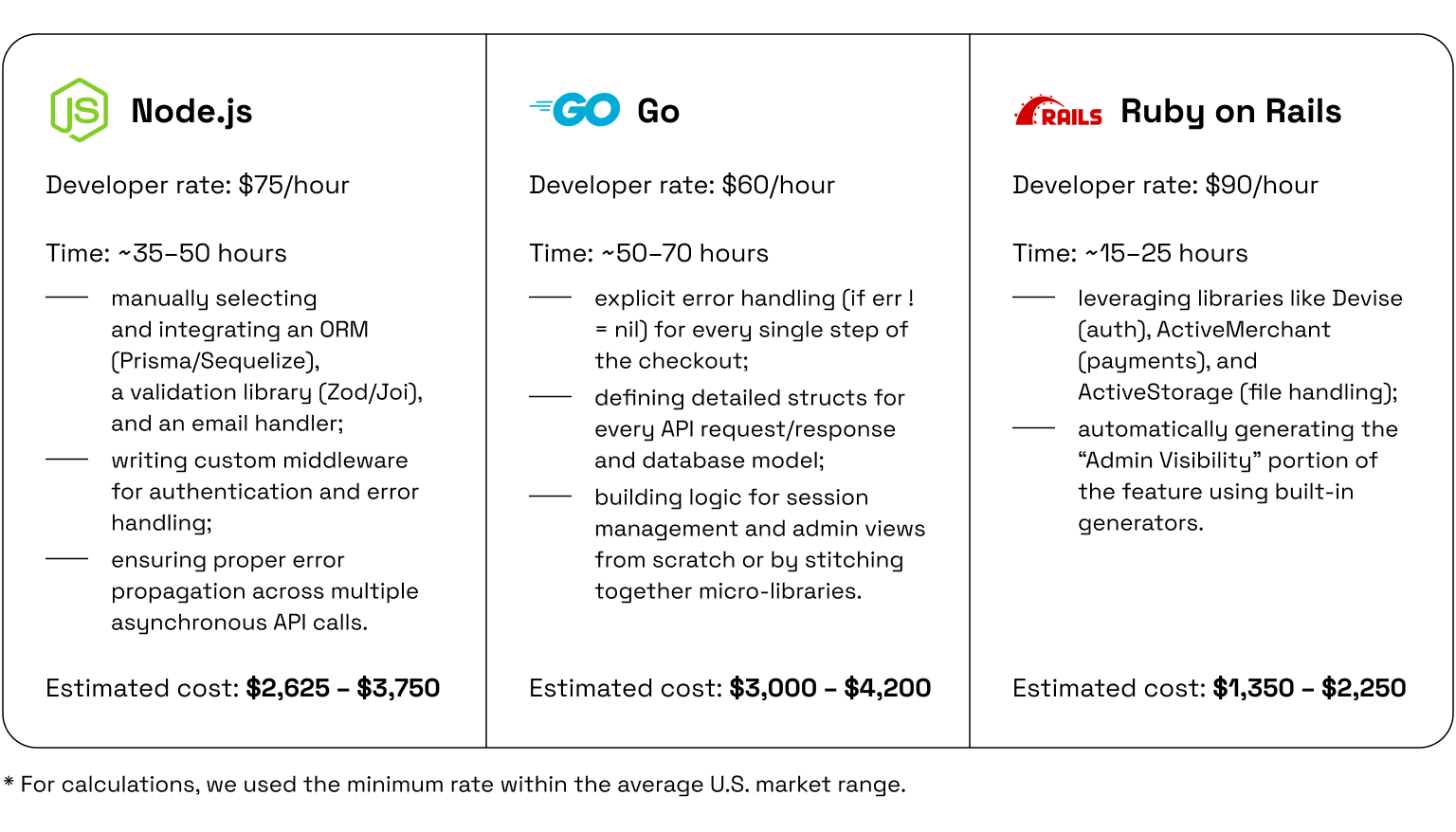
The difference reflects how much of the system an engineer should build manually.
- Node.js reduces language friction, but increases architectural overhead.
- Go minimizes long-term maintenance, but increases initial implementation effort.
- Rails minimizes both decision-making and implementation time for typical business features.
This is why higher hourly rates do not necessarily lead to higher total costs. What is more, for feature-heavy products, the opposite is often true.
SaaS founders must also account for software maintenance, which typically represents 50–80% of a product’s lifetime cost. Rails 8’s internalized infrastructure significantly lowers the 3-year Total Cost of Ownership (TCO) for complex applications, compared to the “rolling refactor” cycles common in Node.js environments.
When evaluating hiring costs, we advise to think in terms of:
- cost per feature instead of cost per hour;
- team throughput instead of individual rates;
- predictable delivery instead of access to a large but uneven talent pool;
- maintenance cost instead of raw MVP development.
How dependent is each backend on external libraries and packages?
Dependencies directly affect:
- how quickly a team can deliver features
- how much infrastructure needs to be maintained
- how predictable the system remains over time
- how much engineering effort is spent on building vs integrating.
The Node.js ecosystem (npm) is the largest and most diverse. A typical Node.js project may include hundreds of dependencies, many of which are small, narrowly scoped packages. This creates a broader maintenance surface:
- regular updates to avoid deprecated or unsupported packages
- compatibility issues between libraries
- additional effort for security audits
That said, the situation is often overstated. Mature and widely adopted packages (e.g., for routing, validation, or database access) are generally stable and well-maintained.
However, in terms of security, external dependencies make your system more vulnerable to attacks. The March 2026 compromise of the Axios HTTP client, a package with over 100 million weekly downloads, illustrates the risk .
In that incident, a maintainer account was hacked. Malicious versions were published that installed a remote access trojan. For teams that didn’t pin dependencies, the compromised version was pulled automatically during Docker builds without any human intervention.
This case highlighted the importance of continuous auditing and careful version pinning.
Go minimizes external dependencies wherever possible. The language’s standard library is sufficiently comprehensive that many production HTTP services, CLI tools, and gRPC servers are built with zero third-party dependencies beyond the standard library itself
This has clear operational advantages:
- deterministic builds (via Go Modules and Minimal Version Selection)
- fewer breaking changes from third-party updates
- reduced security exposure
From a maintenance perspective, this is one of Go’s strongest advantages. Systems tend to remain stable for long periods without requiring constant dependency updates.
The trade-off, which must be acknowledged honestly, is that functionality readily available as a polished gem or npm package may require custom implementation in Go. As a consequence, the time saved on dependency maintenance is partially reallocated to writing application-specific code.
A Rails app needs far fewer direct dependencies than a Node.js app because the gem ecosystem internalizes what Node.js spreads across dozens of micro‑packages. Rails 8 further reduces external dependencies at the infrastructure level, so the situation is this:
- fewer moving parts compared to Node.js
- stronger alignment between libraries and the core framework
- more predictable integration patterns
The security process is also more tractable. You run bundle audit against a known vulnerability database, then execute a phased upgrade plan across development, staging, and production. It’s a structured, manageable workflow. To ensure your existing codebase is secure, consider our code audit services.
How efficiently does each stack support code reuse at scale?
Node.js offers the highest code reuse potential if the business uses React or Vue on the frontend. Sharing business logic (validation, formatting, types) between the browser and the server can save thousands of development hours over the product’s life.
Go also offers the best refactoring ROI. Its strict type system and the lack of complex inheritance mean that large-scale changes to the codebase are safer and faster than in the dynamically typed Ruby or the “loosely typed” JavaScript (though TypeScript mitigates this). In Go, if the code compiles, it is much more likely to work correctly at scale, reducing the cost of technical debt during growth.
Rails promotes architectural consistency through Convention over Configuration, allowing teams to apply standardized capabilities across the monolith. While standard Rails relies on Active Record, larger teams often implement Service Objects or Repositories to scale. The “strangler fig” pattern then allows for the incremental extraction of these modules into microservices as needed.
For a deeper look at structuring Rails applications for long‑term growth, see our guide How to build a scalable MVP with Ruby on Rails.
This consistency has a direct impact beyond engineering. During M&A, technical due diligence evaluates both the product and the codebase’s maintainability. Systems built on predictable structures are easier to assess and integrate; conversely, fragmented architectures increase perceived risk and can reduce valuation due to the anticipated refactoring effort.
The predictability is why Rails remains a ‘safe bet’ for investors. Industry giants like GitHub, Shopify, Airbnb, and Zendesk were all built on Rails and successfully navigated high-stakes acquisitions and IPOs. Their journeys prove that a Rails foundation is not just a startup tool, but an asset that passes rigorous institutional due diligence at any scale.
Does each stack align well with web and mobile development?
Node.js is perfectly aligned with React Native, which means a single team of JavaScript/TypeScript developers can build the web app, the backend API, and the iOS/Android apps. This reduces the TCO by eliminating the need to hire specialized mobile engineers.
Go and Ruby on Rails integrate with mobile applications through well-defined APIs. This makes them equally compatible with both React Native and Flutter. The choice depends more on product requirements than backend technology. For a deeper breakdown of how mobile frameworks compare, and when to choose each, see our analysis of React Native vs. Flutter: which is better for your project.
Both approaches are widely used in enterprise and fintech applications. Read our latest insights on why we choose React Native for Rails ecosystems.
Which backend enables faster AI integration into business logic?
Go’s concurrency model is uniquely suited for building high-throughput inference gateways or embedding lightweight models. Using libraries like ggml or langchaingo, Go handles local model execution with lower memory overhead and higher speeds than interpreted languages.
Node.js and Ruby on Rails excel at the integration layer, calling inference APIs like any other REST or gRPC service. Ruby on Rails generally allows for faster integration of AI agents into business logic; its high-level abstractions enable teams to deploy AI workflows with minimal setup. In contrast, Go requires more upfront effort to define data structures and orchestration.
For practical examples, see AI agents in Ruby on Rails and our guide on implementing AI features with LLM APIs.
The challenges start when a product requires deeper AI coupling, such as real-time vector search or fine-tuned models. While Node.js can now handle complex prompt chaining natively via LangChain.js, Ruby on Rails and Go still frequently rely on external Python services for specialized tasks like model training or custom tensor manipulation.
Conclusion: when Rails beats Node.js and Go
Ruby on Rails does not compete on raw performance or minimal infrastructure usage. However, for a large class of business applications, those factors are not the primary cost drivers.
Rails consistently reduces the time required to move from idea to production. It minimizes architectural decision overhead; relies on mature and well-integrated libraries; enables smaller teams to deliver complete features with fewer coordination points.
Rails is the optimal choice for products characterized by the following attributes:
- the core value proposition involves complex, evolving business rules;
- the team is small to medium-sized and values predictable, maintainable architecture;
- the data model is relational and forms the foundation of the application;
- the business prioritizes feature velocity and long-term operational stability over short-term infrastructure cost optimization.
This description encompasses the majority of SaaS platforms, marketplaces, internal business systems, and customer-facing web applications built today.
At Rubyroid Labs, we’ve worked with products across these categories and beyond. This lets us evaluate each case in context and recommend the stack that fits product needs as well as long‑term business goals.