Best React Native development companies in the USA (2026 Guide)
Mobile agencies are great at selling speed. Fewer are great at shipping apps that survive real users.
React Native in 2026 can match native performance, but the framework won’t save you from bad engineering. Poor architecture, untested integrations, and vague timelines turn into crashes, rewrites, and burned budgets.
This guide covers ten US-based React Native companies with verified production track records. You’ll also learn how to read vendor proposals and spot the teams that overpromise and underdeliver.
React Native New Architecture 2026 overview
React Native’s original bridge serialized every interaction between JavaScript and native code, creating message queues that caused stuttering during scrolling and choppy animations.
The New Architecture eliminated that bridge by letting JavaScript and native code communicate directly. Users now experience smooth, responsive scrolling without lag, apps that launch 30-50% faster, and animations that feel fluid even under heavy load.
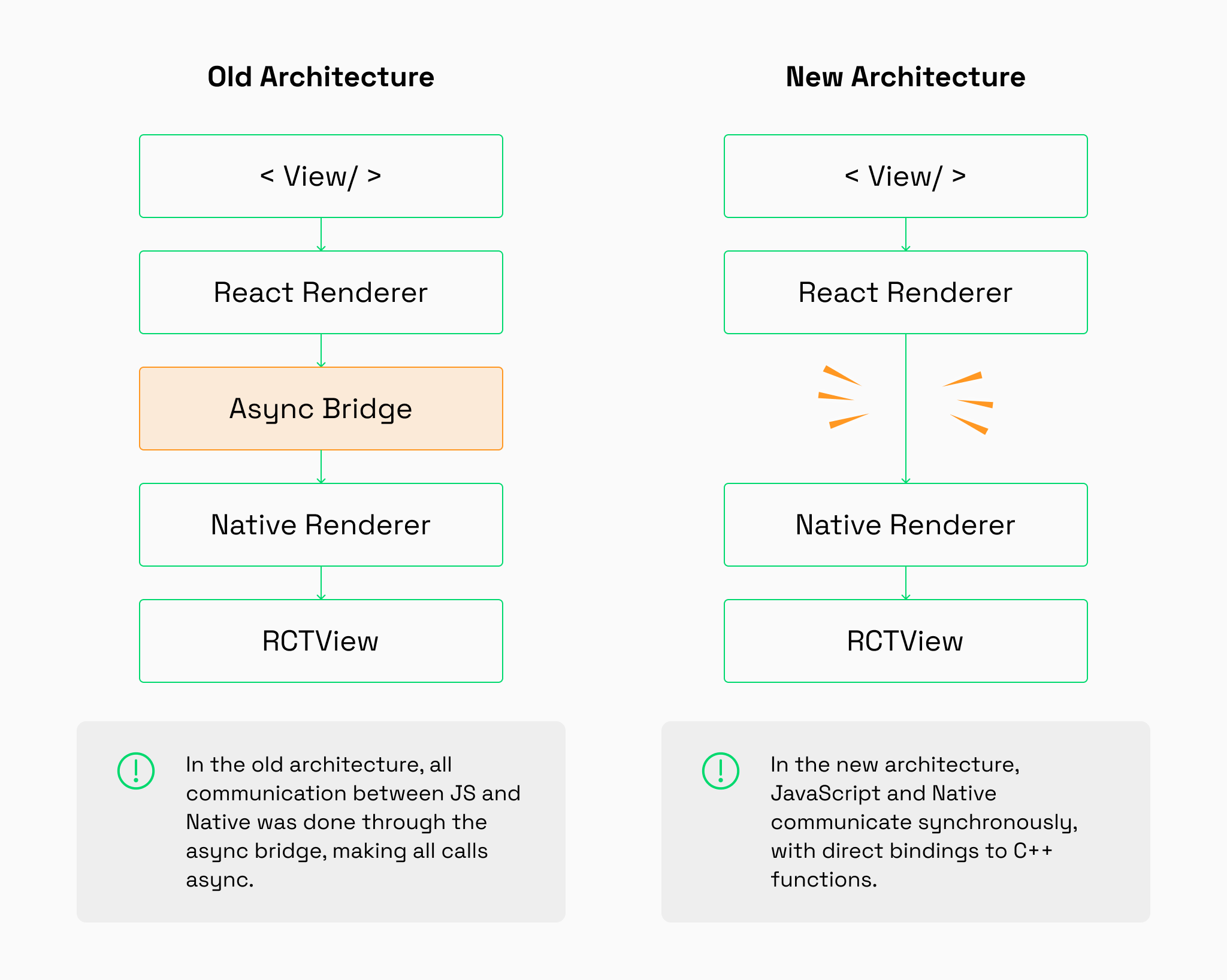
Now React Native stands in the same league as native mobile development. What makes React Native viable in 2026.
1) Architecture that doesn’t bottleneck under load
The New architecture works in the following way:
- Fabric renders UI updates synchronously with no bridge delays: taps and scrolls respond immediately.
- TurboModules load on demand: the camera module loads only if your app uses the camera, cutting startup time and memory usage.
- JSI runs on the same thread as native code: camera, biometrics, and sensors communicate directly without JSON overhead.
No more lag during photo uploads, Face ID checks, or location tracking.
2) Platform-native UI components (not web views)
React Native renders with actual native components such as UIKit on iOS, Android Views on Android, not web views pretending to be native. Transitions, keyboard behavior, and gestures match what users expect on each platform, avoiding the “something feels wrong” friction that drives uninstalls.
3) One codebase, multiple products
One React Native foundation can power multiple apps with platform-specific overrides where needed. Shared business logic, API layers, and UI components reduce duplication, while brand-specific assets, backends, and navigation flows keep each app distinct. Here’s a practical example.
Sail Croatia operates small-ship cruises in the Adriatic across two brands: Sail Croatia and MedExperience. They needed mobile apps for both brands on iOS and Android, 4 apps total.
Technical solution:
With React Native, we built a single codebase powering all four apps. Each app maintains separate branding, connects to its own backend, and pulls from distinct content libraries, with enough differentiation to pass Apple’s “Design Spam” (4.3) guidelines.
Core features: offline mode with cached map tiles, Google Maps integration, real-time content updates via admin panel, booking schedules, excursion materials.
Team: 2 React Native developers, 2 Ruby on Rails developers
Result:

4) Ship fixes without waiting on Apple
EAS Updates lets you push JavaScript and asset updates directly to users without app store reviews. When a production bug breaks checkout or a critical flow, you deploy a fix in hours instead of waiting days for approval.
Updates bypass review because they don’t modify native code, only JavaScript and assets. You can also roll back bad releases instantly.
5) Automated pipelines catch bugs before production
Every code change triggers CI/CD pipelines that test your code and build iOS and Android versions automatically. Bugs get caught before they reach users, and your team can ship updates weekly or daily without manual bottlenecks.
Without CI/CD, releasing even a small fix means coordinating manual builds, testing on multiple devices, and uploading to app stores.
6) AI & ML without a second stack
React Native lets you add AI features to your existing app without rebuilding anything. Call OpenAI, Claude, or custom models directly from TypeScript, or integrate TensorFlow Lite and Core ML for on-device inference. All this on one codebase for both platforms.
Native teams are still coordinating iOS and Android implementations while you’re already testing with users.
The React Native framework is only as reliable as the team behind it, and a bad hire still gets you messy code, missed deadlines, or a sluggish interface.
We looked at the US market, filtered out the agencies that just talk architecture from the ones that actually ship it, and mapped the ten worth your time in 2026-2028.

10 React Native vendors: US market
React Native buys you speed, but it doesn’t forgive weak engineering. If the team cuts corners, you pay it back in crashes, slow screens, and expensive rewrites.
Here are the 10 US-based React Native development firms we’d shortlist for 2026–2027.
| Rank | Company | Best fit | Typical clients | Native expertise | Timezone overlap (US) | Developer rates /hr |
| 1 | Rubyroid Labs | RN+RoR, AI integration, code refactoring, system migration | Startups, mid-market, enterprise | High | Good | $50–$99 |
| 2 | Imaginovation | AI/ML-first, complex apps, high budget | Startups, mid-market, enterprise | High | Good | $50–$99 |
| 3 | Big Human | Design-led, premium UX, brand apps, onshore | Startups, enterprise | Med–High | Good | Undisclosed |
| 4 | Switch Software | High collaboration squads, fast iteration | Mid-market, enterprise | Med–High | Good | $25 – $49 |
| 5 | Cleveroad | Rapid staffing, multidisciplinary | Mid-market, enterprise | Med–High | Medium | $25–$49 |
| 6 | Empirical | Product teams, LatAm staffing, mid‑market | Mid-market, enterprise | Medium | High | $50–$99 |
| 7 | Bytes Technolab | eCommerce, integrations, cost-efficien, delivery teams | Startups, mid-market, enterprise | Medium | Medium | $25–$49 |
| 8 | Intobi | Modernization, RN over APIs, EU talent, mid‑market | Startups, mid-market | Med–High | Medium | $25–$49 |
| 9 | Radixweb | Legacy modernization, process-heavy, large programs | Mid-market, enterprise | Medium | Low–Medium | $25–$49 |
| 10 | The App Scout | MVP/prototype, budget, fast launch, higher risk | Startups, small Business | Low–Medium | High | $25–$49 |
1. Rubyroid Labs
Strategic role: Rubyroid Labs is a full-cycle software development agency based in Springfield, Illinois. With 10+ years in mobile development, we’ve been building React Native apps that stay stable at scale, especially when the product also needs a Rails/API layer.
- Core strength: Parallel mobile and API delivery. Strong React Native + backend pairing with repeatable delivery practices (testing, release cadence) rather than “UI-only RN.”
- Specialties: End-to-end React Native development services • UI/UX design • migrations • code review & modernization plan • AI Integration • team extension • maintenance & support
- When to choose: Your current mobile deployment is failing under load, riddled with technical debt, or completely stalled by severe cross-team communication breakdowns.
- Not the best fit: You need US-hours-only collaboration with heavy same-day pairing.
- Track record: 5.0 on Clutch (55+ verified reviews), clients include Mastercard, Volvo, NNOXX, Elko, and Y Combinator/Seedcamp-backed startups.
2. Imaginovation
Strategic role: US-based partner for higher-budget web/mobile programs where delivery governance and stakeholder alignment are part of the scope.
- Core strength: Running complex, multi-month builds with disciplined PM/communication and budget/timeline control.
- Specialties: Custom software development • mobile app development • web development • AI development • UX/UI design • cloud consulting
- When to choose: You need a partnership with seamless strategic integration into your internal operations and a predictable monthly execution plan.
- Not the best fit: You want a small MVP vendor with low minimums and minimal process gates.
- Track record: 4.9 on Clutch (16 reviews), USC Keck Medicine, Mecklenburg County, CREE Lighting; multi-year partnerships in healthcare/manufacturing.
3. Big Human
Strategic role: New York-based design-first product studio for brand-sensitive digital products where UX and identity are primary drivers of adoption.
- Core strength: Tight integration of design, branding, and engineering in a single studio engagement model.
- Specialties: Product strategy • UX/UI design • branding • web/mobile product development
- When to choose: Design is your competitive edge and you have budget flexibility for top-tier onshore talent.
- Not the best fit: You just need low-cost dev capacity with minimal strategy/design involvement.
- Track record: 5.0 on Clutch (6+ reviews), Quinn, RoomZoom.
4. Switch Software
Strategic role: Nearshore delivery partner for US product teams that need high collaboration overlap and the ability to run large, multi-squad programs.
- Core strength: Scaling delivery teams while maintaining predictable cadence and stakeholder communication.
- Specialties: RN augmentation • comprehensive cloud consulting • custom software development • ServiceNow integrations • cybersecurity
- When to choose: You need synchronous daily collaboration, nearshore engineering augmentation, and unparalleled availability during core North American business hours.
- Not the best fit: You require 24/7 Asia-Pacific coverage, need lowest rates, or want design-first agency.
- Track record: 4.8 on Clutch (21 reviews), praised for exceptional market knowledge, highly competitive pricing, and successful integration with high-end US corporate clients.
5. Cleveroad
Strategic role: High-capacity engineering vendor used to staff and deliver multiple workstreams (web, mobile, platform) under one commercial relationship.
- Core strength: Rapid team ramp (mobile + backend + QA) with cost control in mid-market pricing bands.
- Specialties: React Native app development • cross-platform mobile apps • product discovery • UI/UX • backend/API development • maintenance & support
- When to choose: you need 10+ senior engineers fast, you operate in regulated industries.
- Not the best fit: You’re a bootstrapped startup, need a single developer for a 3-month MVP, or want boutique personal attention.
- Track record: 4.9 on Clutch (80+ reviews), renowned for highly mature internal processes and successful execution in healthcare, financial technology, and global logistics.
6. Empirical
Strategic role: Staff-augmentation and team-building partner for scaling engineering via Latin America talent with an embedded team model.
- Core strength: Building long-lived product teams (hiring + ongoing support) rather than filling isolated roles.
- Specialties: Staff augmentation • dedicated teams • product development support • recruiting and team assembly
- When to choose: You need onshore accountability and synchronous collaboration without $150+/hr rates, perfect for mid-market U.S. companies.
- Not the best fit: You have a low-budget project (under $50,000) or just need a simple, transactional prototype build.
- Track record: 4.9 on Clutch, known for high customer satisfaction and long-term U.S. partnerships.
7. Bytes Technolab
Strategic role: Digital transformation vendor with a commerce/platform center of gravity, used when mobile sits inside an integration-heavy program.
- Core strength: Commerce ecosystem execution (platform + integration delivery) rather than mobile-only builds.
- Specialties: eCommerce development • enterprise platform implementation • custom software development • mobile/web development • integrations
- When to choose: Your RN app depends on commerce workflows (catalog, checkout, order lifecycle) and you need reliable integration delivery.
- Not the best fit: You need a pure-play React Native specialist for advanced mobile performance work with minimal platform scope.
- Track record: 4.9 on Clutch (52 reviews).
8. Intobi
Company profile: Cost-efficient full-cycle software development company offering React Native development services as part of broader mobile and technology capabilities.
Core strength: Shipping RN plus backend contributions under one team.
Specialties: React Native development • native modules (Swift/Kotlin/C++) • MVP delivery • enterprise mobile • integrations/APIs • support & maintenance
When to choose: You want a build partner for an MVP or modernization that requires RN plus backend work under one delivery owner.
Not the best fit: You want purely onshore teams, need 24/7 U.S. timezone coverage, or can’t manage async communication.
Track record: 4.9 on Clutch (53 reviews), transparent processes, successful enterprise migrations.
9. Radixweb
Strategic role: Large-scale engineering provider for multi-quarter modernization where governance and predictable execution matter more than boutique craft.
- Core strength: Program-scale staffing and delivery processes suitable for complex, integration-heavy modernization.
- Specialties: custom software development • enterprise application modernization • React Native deployment • AI development • cloud-native architectures
- When to choose: You have a modernization program with multiple systems and need a vendor that can staff and govern it at scale.
- Not the best fit: You need a small senior discovery team for high-ambiguity product shaping in the first 2–4 weeks.
- Track record: 4.8 on Clutch (52 reviews), successful cloud-native transformations at scale.
10. The App Scout
Strategic role: Mobile build vendor for MVPs and early-stage apps where speed-to-launch and commercial viability are the primary goals.
- Core strength: Fast MVP execution with low minimum engagement and standard mobile delivery scope.
- Specialties: mobile application development • React Native • user interface design • MVP prototyping
- When to choose: You need a straightforward MVP shipped quickly with low minimums and a $25–$49/hr pricing band.
- Not the best fit: You require enterprise-grade security/compliance artifacts and formal release governance as contractual deliverables.
- Track record: 4.6 on Clutch (10 reviews).

What to ask vendors before signing
Many vendor proposals stay intentionally vague around architecture ownership, delivery scope, and upgrade responsibility. Terms like “senior team,” “scalable architecture,” and “agile process” sound reassuring but lack the specifics needed to evaluate real capability.
Good vendors can explain clearly their architecture decisions, sprint breakdowns, and how they’ve handled production challenges. Weak vendors stay abstract because they’re inexperienced or avoiding commitments.
Below are common proposal phrases and the questions that reveal real expertise.
“Full-stack mobile development”

- What it usually means: They can build screens and basic APIs, but may not have owned production-grade backend reliability.
- What to ask: “Show a recent architecture diagram and explain how you handle auth, payments, rate limits, monitoring, and incident response.”
“We use Expo for faster delivery”

- What it usually means: They may avoid native work; the project can stall when deeper SDK integration is required.
- What to ask: “Are we starting with Expo managed, Expo dev client, or bare RN? What features would require switching, and what’s the migration plan?”
“Timeline: 12–16 weeks”

- What it usually means: A range without a build plan, unknowns are hidden in the buffer.
- What to ask: “Break the timeline into phases with deliverables: what ships when, what’s in/out, and what could shift the date?”
“We provide ongoing support and maintenance”
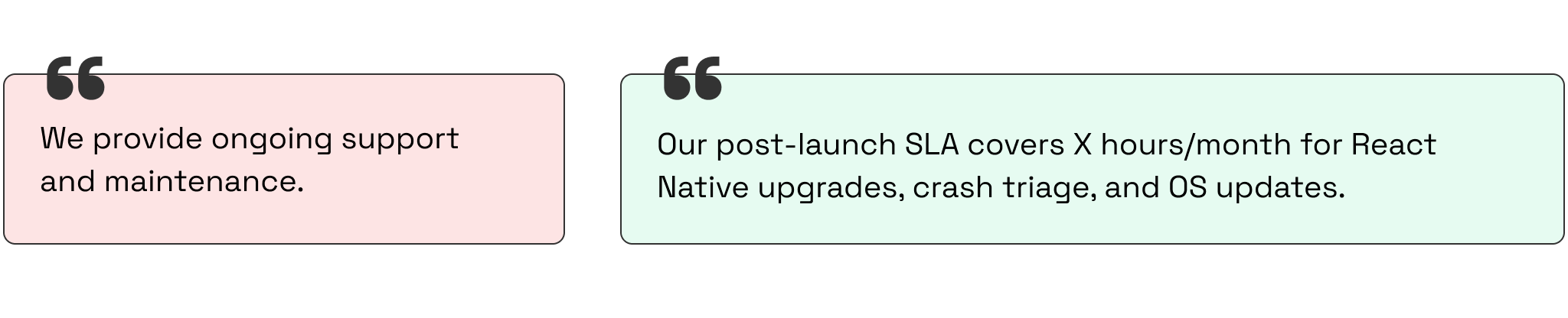
- What it usually means: Either real structure or expensive-sounding words with no boundaries.
- What to ask: “What’s included in support? React Native version upgrades? Crash response time? Monthly hours?”
“Our team has extensive React Native experience”
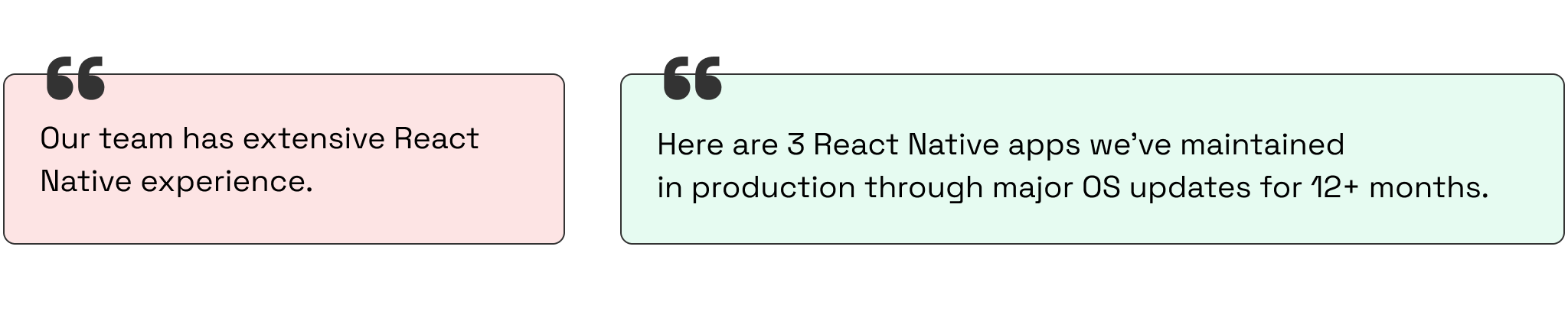
- What it usually means: They’ve used React Native, but you don’t know if they’ve scaled and maintained apps long-term.
- What to ask: “Which apps have you maintained for 12+ months? Who owns releases? What’s your upgrade and crash triage process?”
A strong partner doesn’t hide uncertainty in vague language.
At Rubyroid Labs, we ask hard questions upfront, map out architecture before quoting timelines, and tell you when scope needs adjustment because we’ve seen what breaks under real-world load.
When React Native is the wrong choice
React Native is a strong default for many mobile products but it’s not universal. If your app’s success depends on pushing device capabilities to the edge, the “cross‑platform tax” can show up as performance risk, longer debugging, and more native work than planned.
Here’s when not to choose React Native.
| Scenario | Why native is better |
| Heavy real-time processing | Video editing with complex filters, professional audio production, AR apps with intensive 3D rendering, real-time computer vision. |
| Platform-specific innovation | Apps built around brand-new iOS/Android APIs (within first 6–12 months of release) or requiring deep integration with unreleased OS features where React Native support lags. |
| Performance-critical games | Fast-paced 3D games with complex physics, games with heavy particle effects when every millisecond of render time matters |
| Highly regulated environments | Banking apps where regulators explicitly require native code, medical devices subject to FDA approval with native-only guidelines, industries where cross-platform frameworks create certification barriers. |
| Native-first team with tight deadlines | When you have experienced iOS/Android engineers but no JavaScript expertise, and retraining costs outweigh React Native’s benefits. |
React Native handles 80–90% of mobile app use cases well. But when real-time performance, bleeding-edge platform APIs, or strict regulatory requirements dominate your roadmap, native is still the safer bet.
Final point: choosing a vendor wisely
React Native in 2026–2028 is mature enough for building stable and performant mobile apps. But the main deciding factor is still the partner choice and their skills.
Strong vendors specify: how performance stays stable under load, how native module risks are managed, who owns releases, and how quality is enforced through CI/CD, monitoring, and crash triage.
Weaker vendors stay abstract: “agile timelines” and “scalable architecture” without showing sprint deliverables or concrete upgrade plans.
So, evaluate vendors like engineering partners, not contractors. Ask for production apps they’ve maintained past launch, their React Native upgrade track record, and their observability setup, not just case studies.
The framework is mature. Your vendor choice is what makes or breaks the project.

FAQ
It depends on your constraints, but for many business apps in 2026–2027 React Native is often the lower-risk long-term choice.
Hiring: JS/TS talent is broad, so staffing is usually easier than Dart-heavy teams.
Platform feel: Native components tend to match iOS/Android behaviors with less UX friction.
Integrations: For SDK-heavy apps (payments, auth, analytics, device APIs), RN integration paths are typically straightforward.
Flutter can be a strong fit when you need pixel-perfect cross-platform consistency or graphics-heavy custom UI, but you may take on more dependency risk via packages.
For the full comparison, see: React Native vs. Flutter (2026–2028).
Yes. React Native can work with camera, GPS, Bluetooth, biometrics, push notifications, deep links, storage, and most device APIs.
Our approach:
– using well-supported RN libraries for common needs
– integrating vendor SDKs (e.g., Stripe/Firebase) via established RN patterns
– building Swift/Kotlin native modules when the project hits edge cases
The real variable is team experience with native iOS/Android work for the cases where it’s required.
React Native is production-ready, but boundaries still exist:
– Upgrades take planning: skipping versions builds dependency debt quickly.
– Not a game engine: heavy 3D/real-time graphics need a dedicated engine.
– Platform differences are real: native components mean iOS/Android won’t look/behave 1:1.
– Native expertise still matters: SDK-heavy apps will hit cases that require Swift/Kotlin.
These are manageable with continuous upgrades, a real-device test matrix, and clear performance/release discipline.
Yes, migration from native to React Native is common. Most migrations follow one of three paths:
– Full rewrite (when current architecture blocks progress).
– Phased migration (move feature areas incrementally).
– Progressive UI replacement (keep backend/design stable while RN takes over the UI gradually).
The right approach depends on what must stay native, what to move first, and how to stage releases without hurting ratings. We also handle Flutter → React Native migrations.
In both cases, we begin with a code audit so timelines and budgets reflect the real scope.
Navigation and deep linking break first, especially when apps return from the background or handle push notifications. After that:
– Inconsistent native module behavior across iOS/Android versions
– Performance issues from unoptimized list rendering
– Memory leaks in image handling
These rarely show up in demos but surface immediately under real user patterns.
– Minor upgrades (0.74 → 0.75): 1–3 days if your codebase is clean
– Major upgrades (0.71 → 0.74): 1–2 weeks, especially with deprecated APIs or older libraries
– Delayed upgrades (12+ months behind): 3–6 weeks of migration work plus dependency rewrites
The real cost comes from neglect, skipping upgrades compounds the effort later.