How to take over an existing Ruby on Rails application from another team

Changing the team behind a Rails application does not stop the product clock. Bugs, releases, fragile code, production issues, and critical business flows still need to be handled by developers who are just learning the codebase.
At Rubyroid Labs, we start a Rails takeover with verification: codebase, dependencies, CI/CD, infrastructure, documentation, and critical flows. AI agents help us inspect the project faster and surface issues earlier, while engineers validate findings and decide what needs attention before feature work starts.
This article shows how to take over a Ruby on Rails application without disrupting ongoing work, based on the process we have refined across 230+ digital products, including Rails takeovers.
Key takeaways for a safe Ruby on Rails application transition:
- Review the application before starting feature work
- Verify code, infrastructure, releases, and critical flows first
- Keep the handover clear: access, risks, documentation, and small controlled changes
What makes a Rails application takeover risky?
A Rails takeover becomes risky when the new team starts changing the application before they understand three things: hidden dependencies, release process, and business-critical flows.
Access helps, but it does not explain why the application works the way it does. A repository, task tracker, staging environment, and documentation are only the starting point.
The main risks usually appear in three places.
1. A simple change may hide fragile logic
A small change in a Rails app can touch callbacks, background jobs, permissions, reports, exports, or third-party integrations. Before making the change, the new team needs to trace those connections and understand which behavior must stay intact.
The risk: The task starts with investigation, estimates stretch, and the first delivery takes longer than expected.
2. The next release is unclear
Finishing a ticket is not the same as releasing it. The team needs to know how the application is tested, deployed, monitored, and rolled back.
If the release process is undocumented or half-manual, the next deploy turns into guesswork.
The risk: A release is delayed while the team restores the process, or it goes ahead before anyone is ready to handle a production issue.
3. The handover misses hidden context
Access and documentation may be transferred, but the reasons behind old decisions often stay with the previous developers.
A redundant-looking code path may protect a customer-specific workflow. An outdated gem may be pinned because a newer version broke payments. A strange deployment step may exist because one integration fails without it.
The risk: The new team can make a reasonable-looking change that breaks behavior nobody thought to mention.
To move through a Ruby on Rails takeover without disrupting the product, you need two things: an experienced team and a clear process for turning an inherited application into something the new team can safely support and develop.
Here is how this process works at Rubyroid Labs.
The Ruby on Rails application takeover process
When we start a Ruby on Rails application takeover, we first build a clear technical picture of the project.
Before planning serious feature work, we look at how the application is built, how it is released, where the main risks are, and which parts of the product are business-critical.
In practice, our takeover process usually includes six stages: access setup, AI-assisted technical audit, product context, risk prioritization, knowledge transfer, and small controlled changes.
01. Collecting access and setup details
First, we ask for access to the tools where the existing Ruby on Rails application lives and where the team’s work is managed. The most important starting point is the codebase and project context. The checklist below shows the access areas we usually need during a takeover, but not all of them are required on day one.
Usually, that includes
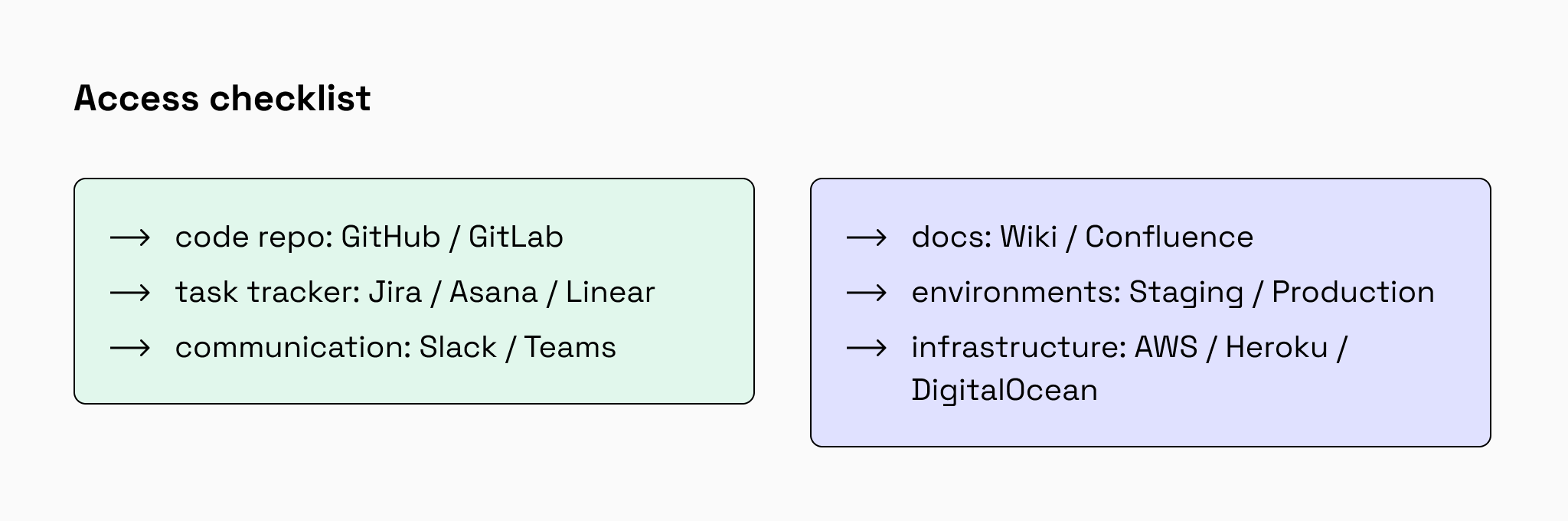
Production and infrastructure access usually come later, when they are needed for releases, debugging, monitoring, or infrastructure review. We can often start safely with repository access, staging, documentation, CI/CD configuration, deployment notes, and architecture walkthroughs.
For US and European companies, production access may involve security, legal, compliance, and data protection requirements. Depending on the product and jurisdiction, this may include GDPR or CCPA, HIPAA for US healthcare data, PCI DSS for payment card data, SOC 2 controls, or internal security policies.
When production access becomes necessary, we follow the client’s security process: role-based permissions, SSO or VPN, audit logs, temporary credentials, approved access windows, and NDA or data processing requirements where needed.
At this stage, we are not changing the application yet. First, we need to understand where the code lives, how work is managed, how releases happen, what access is available, and who can answer questions during the first weeks.
02. Run a technical audit of the Rails app
Once we have basic access, we run a Rails application audit before moving into major development work. This helps us understand the product’s current state and avoid making changes blindly.
From there, the next step depends on what we find. A stable app can move into development faster. A risky one needs stabilization first: refactoring fragile areas, adding tests, resolving security problems, or cleaning up releases before larger work begins.
At Rubyroid Labs, we have used this approach for years across Rails, React, and React Native projects. In 2026, we also turned part of our Rails audit workflow into an open-source Rails audit skill for our AI agents.
The skill guides an agent through a structured Rails code audit checks we use in practice: project discovery, automated checks, manual code review, and a structured report with Critical, High, Medium, and Low findings, plus an overall 0–10 score.
We use it to make the initial audit faster and more consistent. It helps our engineers get project context sooner, but it does not replace their judgment. Our developers still review the source code, validate findings, and decide which issues matter for the business and which can wait.
03. Understanding your product and critical business flows
Along with the technical review, we need to understand how your product works from a business point of view.
Usually, we clarify this through calls with you or the previous team. We ask about:
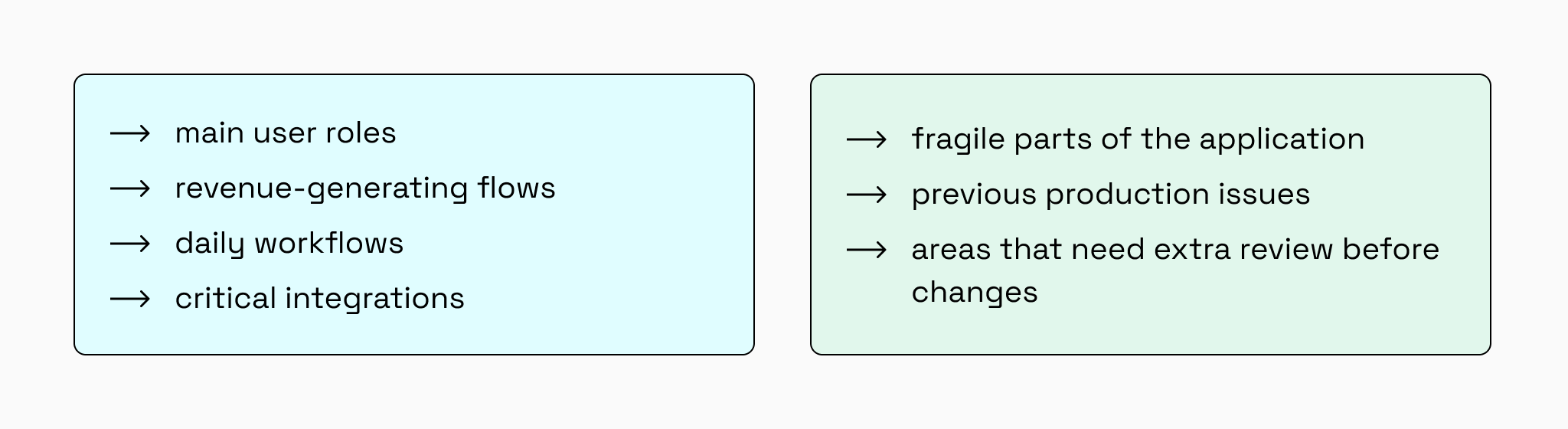
For example, the critical flow may be subscription renewal, booking, payment confirmation, admin approval, inventory sync, or a nightly export. If these flows create performance bottlenecks or release risks, mapping them early helps us plan future improvements, such as moving non-critical work to background jobs after the takeover is stable.
We do not document every business process before touching the code. Instead, we combine what we see in the application with what you explain during calls. This gives us enough context to work safely without turning the takeover into a months-long discovery phase.
04. Prioritizing technical risks
After the audit and product-context review, we separate findings into what needs to be fixed now and what can wait. AI-assisted reports help us collect and group findings faster, but the final priority is set by engineers based on production risk, business impact, and the current roadmap.
If test coverage is weak, we usually add tests around critical flows before changing them. If controllers or models are too large, we may refactor them gradually while working on related tasks. If the project is stuck on an outdated version, we assess whether it creates immediate security risks or needs a separate upgrade roadmap.
For example, here is how we approach a Rails 5/6 to Rails 8 upgrade without downtime.
The result is a clear priority list: what blocks safe work, what creates production risk, and what can be improved later.
05. Transferring knowledge and keeping documentation practical
If the previous developers are available, we use the first weeks to collect practical knowledge from them.
Most often, this includes:
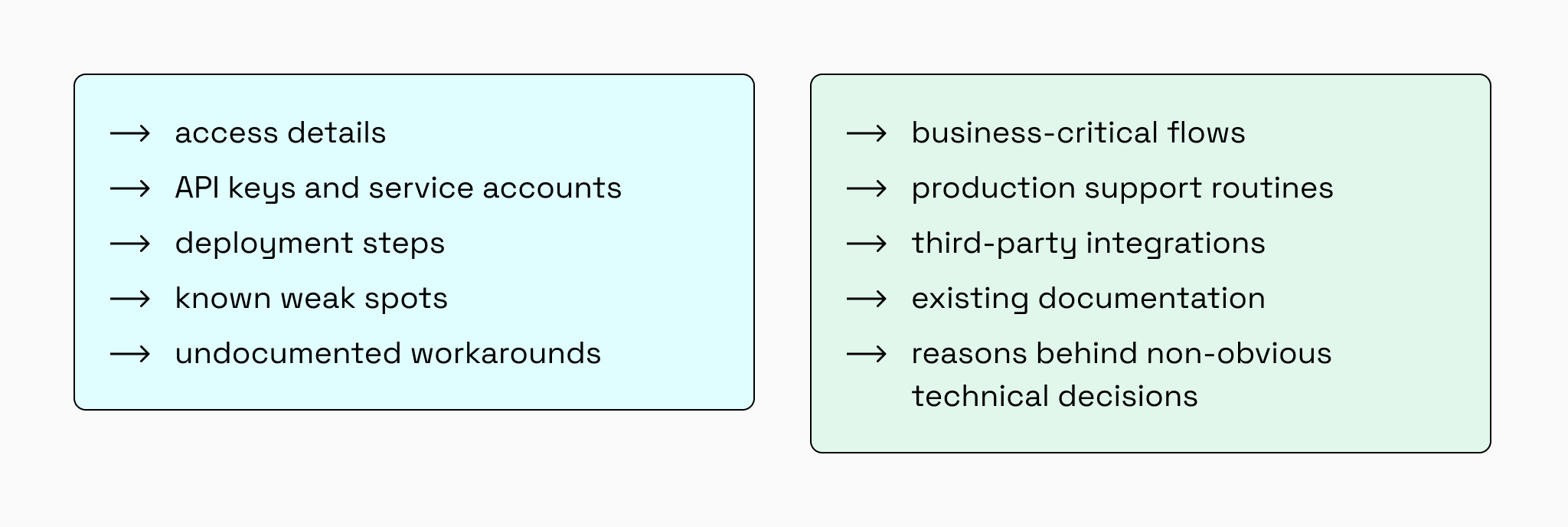
Sensitive access is handled separately. Secrets, API keys, Rails credentials, SSH keys, deploy keys, CI tokens, and service accounts should be shared through a password manager or secrets manager, not written into documentation. Where needed, we also help revoke unnecessary access from the previous team and rotate sensitive credentials after the ownership transfer.
If the previous team is no longer available, the takeover is still possible. Usually, the code, database, repositories, and service accounts give our developers enough information to restore the working picture. If an account is missing or still owned by the previous vendor, we first try to recover or transfer ownership safely.
To keep the context, we also record handover calls when possible. AI can help summarize discussions, extract setup steps, risks, and open questions, but engineers still turn the useful parts into practical documentation: setup instructions, deployment notes, environment variable names and ownership, release checks, and known risks.
We document only what helps our team work with the application in practice: setup, releases, risks, conventions, and the context needed for future development.
06. Starting with small, controlled changes
Once we understand the codebase, product context, and main risks, we start development carefully. At this point, we need to prove that the new team can work through the full delivery cycle without putting the product at risk.
Typical takeover milestones
- Week 1–2: access setup, codebase review, risk mapping, and small controlled changes. A production release is possible only after the deployment path, monitoring, and rollback process are clear. If we do not yet own production access, the release can go through the client’s or previous team’s existing pipeline.
- Starting from week 2 and further: we gradually take responsibility for releases, support, and larger development tasks as access, project context, and release safety become clear.
These milestones depend on access, project condition, compliance requirements, and documentation quality. If the audit shows serious risks, we first fix what blocks safe delivery: missing tests around critical flows, unstable Rails CI/CD, security vulnerabilities, release instability, or dependencies that create security or support risks.
We don’t make large architectural changes unless the audit shows they are necessary for stability. In most cases, small controlled changes are the safest way to move from takeover to regular development.
Because every inherited application comes with a different level of access, documentation, and technical debt, we keep the Ruby on Rails application transition process explicit and transparent: what we check, what we find, what blocks safe work, and what we recommend doing next.
This gives you a clear view of the transition without having to read every technical detail line by line.
How to work alongside the existing development team
In almost all Rails projects we took over from other teams, clients had the same concern: how to switch Ruby on Rails development teams without disrupting the workflow.
The existing developers still had tasks and releases to handle, while we needed time to learn the application and take responsibility safely. That works only when two things are clear from the start: what access the new team has, and who owns each piece of work.
Parallel team collaboration
During a Rails application takeover, the existing team can keep handling tasks and releases while we learn the codebase and start with a small task. To avoid overlap or confusion, we agree on who will make and review each change and who will handle any issues after release.
Gradual responsibility transfer
We take responsibility for each part of the application once we understand it well enough to manage it independently. If the existing team is available, we can get there in stages rather than handing over everything on a set date.

Observe
We follow an existing developer through a task or release to understand decisions that may not be documented.
Assist
Our team makes a small change while the existing developers are available to answer questions and review it.
Co-own
Both teams work in an agreed area, with clear responsibility for decisions and production issues.
Own
Responsibility for changes and support moves to our team, without day-to-day reliance on the previous developers.
If the previous team has already left, these stages may not be possible. In that case, the Rails application audit, AI-assisted code exploration, client conversations, and small first changes help us build the context we need.
Adding Ruby on Rails developers to your current team
You might not need a full Rails project handover. Your existing team may simply need more capacity for feature development, Rails maintenance, refactoring, or infrastructure work.
In that case, our developers can join your team’s communication channels, task tracker, Ruby on Rails code reviews, and delivery routine in as little as 3 business days, without introducing a separate process.
Through our Ruby on Rails development services, we can support your current team, take over selected areas, or continue development after the transition is complete.
How long does a Rails project takeover take?
There is no fixed timeline for a Ruby on Rails application takeover. We can start the review once we have basic access, but ownership of releases and ongoing development depends on the project’s condition.
The process is faster when documentation is clear, tests are reliable, deployment steps are known, and the previous developers are available for questions. It takes longer when a legacy Rails application has weak test coverage, unclear infrastructure, outdated Ruby, Rails, or gems, undocumented business logic, or compliance limits around production access.
AI agents help us scan the codebase, dependencies, security issues, and common Rails patterns faster. They shorten the first review, but the final timeline still depends on access, risk level, and release safety.
If the product needs active development while the takeover is still in progress, the safer option is to start with limited responsibility: one engineer joins the existing workflow, handles scoped tasks, and expands ownership as the project context becomes clearer.
For this format, you can hire Ruby on Rails developers who integrate into your team’s sprint cadence instead of replacing the whole process at once.
5 red flags in a Rails application takeover
Not every takeover risk starts in the codebase. In 13+ years of working with Ruby on Rails application transitions, we’ve seen many issues come from decisions made too early: rewriting before understanding the product, changing too much at once, ignoring infrastructure, or leaving ownership unclear.
Here are the red flags we watch for when taking over an existing Rails application.
01. Rewriting the application too early
A rewrite can look tempting when the codebase is old, messy, or hard to understand. But rewriting before the team understands the product logic, users, integrations, and revenue-critical flows can create more risk than the original application.
Our approach:
We stabilize the app first, identify the parts that create real business or technical risk, and only then decide whether Rails application modernization, refactoring, or rewriting specific parts makes sense.
02. Ignoring infrastructure
A Rails takeover is not only about the repository. The application also depends on deployment scripts, background jobs, queues, cron tasks, environment variables, cloud services, monitoring, logs, and rollback options.
Our approach:
We review the application’s infrastructure together with the codebase, including the Rails deployment process and production environment when access is available.
We also check for common cost leaks: oversized Puma or Sidekiq workers, inefficient database pools, Redis growth, noisy logs, and autoscaling rules that hide slow jobs or queries. This helps the team release, debug, and avoid paying for idle infrastructure.
Learn more about our approach to Rails infrastructure optimization and cost reduction.
03. Focusing only on code quality
Clean code matters, but it is not the whole picture. A technically messy part of the application may support a critical business flow, while a clean-looking area may be rarely used.
Our approach:
As part of the Rails codebase review, we do not treat technical findings in isolation. We discuss product context with the client or previous team to understand which flows are business-critical, which ones users rely on daily, and which failures would hurt the business most.
04. Changing too many things at once
A new team may want to fix everything immediately: update gems, refactor old code, change deployment, clean tests, reduce technical debt, and ship new features at the same time. In a legacy Rails application, this makes early bugs and release issues harder to trace.
Our approach:
We separate urgent fixes from improvements that can wait. Not all Rails technical debt is an emergency. Some issues block safe development, while others belong in an application maintenance or modernization plan.
05. Failing to define ownership
A takeover becomes messy when nobody is sure who owns reviews, releases, production issues, infrastructure, third-party services, or stakeholder communication.
Our approach:
We define ownership early, especially when the previous team is still involved. This keeps the Rails development team transition clear and prevents responsibility from falling between teams.
The transition works best when risks are identified before they turn into release delays, production issues, or unclear ownership.
What a successful Rails application takeover looks like
A successful Rails application takeover gives the business control. The new team understands how the application works, where the risks are, and how to keep development moving without depending on the previous team.
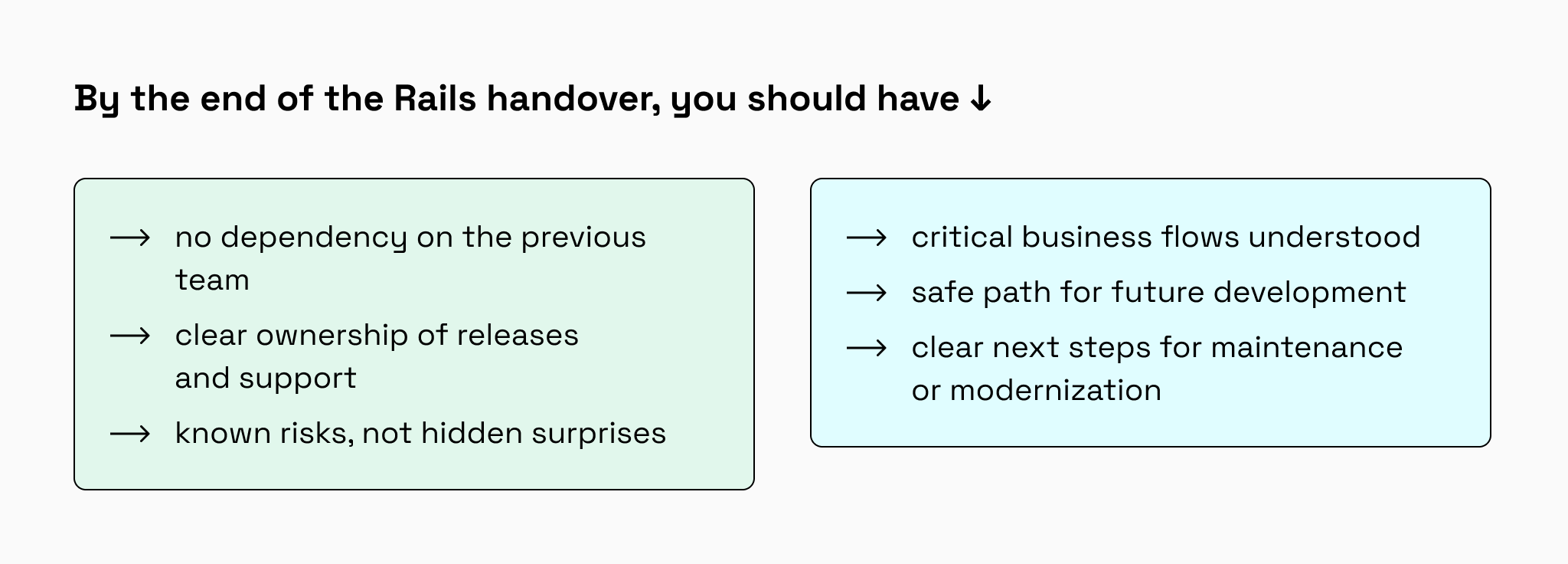
This is the point where the transition stops being a risk and becomes a stable base for ongoing Ruby on Rails maintenance, modernization, or new product development.
Final words
Switching Ruby on Rails development teams is safest when the transition is verified before full responsibility moves to the new team.
The right partner should help you understand the codebase, protect critical business flows, define ownership, and keep releases moving without unnecessary risk.
If you are planning a Rails project handover, Rubyroid Labs can help you take over, stabilize, maintain, and develop your Rails application with a clear process from audit to ongoing delivery.