Scaling a multi-user
automated trading
platform
Modernized a single-user trading middleware into a scalable, multi-tenant platform with accurate real-time P&L calculations and stable order processing.
Business context
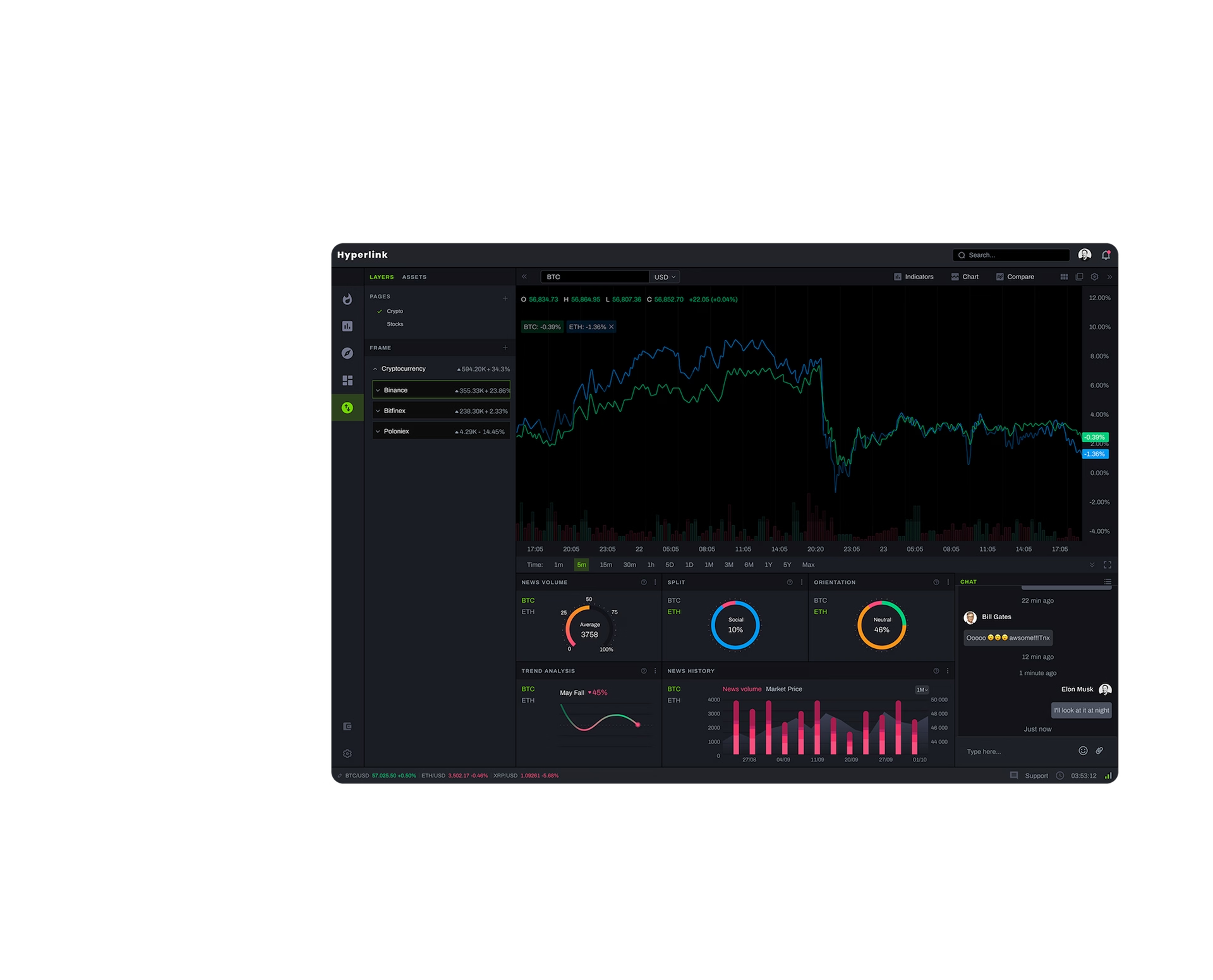
Hyperlink is a backend trading automation platform operating in the financial services industry. It acts as a server middleware, seamlessly integrating TradingView webhook alerts with multiple brokerage APIs. The platform enables traders to automate scalping and swing trading operations.
Project in facts
- Fintech
- USA
- JavaScript developer
- January 2025 - March 2025
- JavaScript development, Staff augmentation
- Node.js, Express.js, SQLite, Jest
Challenge
The client's trading middleware had proven its core concept but lacked the architecture required for commercial scaling. The platform supported only one user at a time, relied on inaccurate Profit & Loss calculations, and contained legacy components that reduced system reliability. They needed a scalable solution capable of executing parallel trades for multiple users as well as delivering accurate financial calculations and stable order processing.
Product goals
- Support multi-tenant trading with isolated user and broker configurations
- Deliver accurate, market-driven Profit & Loss calculations
- Ensure reliable, fault-tolerant trade execution and order processing
Solutions
We re-engineered the platform around a multi-tenant trading architecture, introducing a dedicated management layer to execute user trades in parallel while keeping broker configurations fully isolated. This required redesigning the core execution flow to support independent trading contexts and secure concurrent account operations. Meanwhile, we rebuilt the order persistence model to enhance trading data consistency and lifecycle management.
A significant focus involved reimplementing the Profit & Loss (P&L) calculation logic to use session open and previous candle close prices as reference points, aligning results with real market behavior. We also cleaned up legacy broker integrations and refactored API adapters to minimize system complexity. Finally, we expanded test coverage across critical flows to mitigate regression risk during future trading platform development.
Multi-tenant trading architecture
Dedicated management layer for parallel trade execution with fully isolated broker configurations
Realistic P&L calculations
Reimplemented logic using session open and previous candle close prices
Regression protection
Expanded test coverage across critical trading flows to ensure stability during future trading software development
Engineering approach
We built modular backend architecture on Node.js and Express.js, separating order processing, broker communication, and P&L calculations into discrete service layers. To handle concurrent trading securely, we implemented a multi-tenant design pattern at the core of the execution flow, ensuring strict isolation of user data and broker configurations.
To maximize market coverage, we built a broker-agnostic integration layer that standardizes communication with Trade Station, IBKR, Alpaca, and TD Ameritrade. This architecture seamlessly supports multiple order types and strategy flows across various brokerage APIs without requiring changes to the core trading engine.
Finally, the P&L module was synchronized with live market price feeds to guarantee real-time accuracy. The infrastructure is backed by automated Jest testing and GitLab CI/CD pipelines, deployed on Google Compute Engine, and managed in production via PM2.
Result
Rubyroid Labs transformed a single-user trading middleware into a scalable platform capable of supporting automated trading across multiple users.
-
Multi-user trading platform
A modular backend architecture enables the client to introduce new trading strategies, broker integrations, and platform capabilities, removing the primary limitation that prevented product growth. -
High-precision calculation engine
Corrected Profit & Loss calculations and redesigned order processing provide accurate trading data, increasing confidence in automated trading decisions.

The management was great, and the follow-up was wonderful. The programmer assigned was fantastic, and we continue to build a relationship. I look forward to our next upgrades and working with Rubyroid Labs.
Daniel Jin Park, CEO, Hyperlynk LLC 
Hit a scalability wall? Start with a tech audit
Please fill out this form, and our manager will contact you within one business hour. If necessary, we can sign an NDA and begin project discussions.

Thank you.
Your message has been sent successfully!
We’ll get in touch with you within 24 hours, excepting requests received on Saturday, Sunday.